A pentacle scratched into a candle.
A crescent moon hanging from a necklace.
A strange symbol carefully drawn inside a Book of Shadows.
A spiral carved into stone.
Symbols are everywhere in witchcraft.
They appear on altars, jewellery, candles, Tarot cards, ritual tools and spellwork. Some have histories stretching back thousands of years. Others belong to particular religions or cultures. And some of the symbols now strongly associated with witchcraft have acquired those meanings surprisingly recently.
For someone beginning witchcraft, it can be confusing.
What do witchcraft symbols actually mean?
Is a pentagram the same as a pentacle?
Why is the moon associated with witches?
What do elemental triangles mean?
And are all those “ancient witch symbols” circulating online really ancient?
Not always.
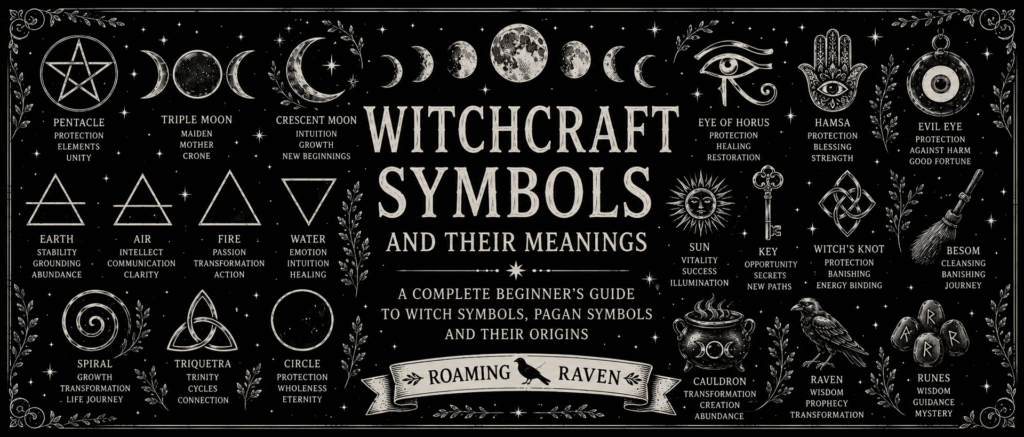
So in this guide, we’ll explore some of the most recognisable symbols used within witchcraft, Paganism and magical traditions, where they come from, and what they can mean in modern practice.
Why Are Symbols Used in Witchcraft?
A symbol allows a complicated idea to be represented by a simple image.
Think about a wedding ring.
Physically, it is simply a circle of metal.
But culturally and personally it can represent:
- Love
- Commitment
- Partnership
- Continuity
- Marriage
Magical symbols work in much the same way.
A practitioner might use a symbol to represent:
- Protection
- An element
- A deity
- A planet
- An intention
- A spiritual concept
- A particular magical tradition
Drawing or wearing that symbol can become a way of focusing attention on what it represents.
Symbols therefore don’t necessarily possess one universal magical meaning.
Their meaning comes from history, culture, tradition and context.
The Pentagram
Perhaps no symbol is more strongly associated with modern witchcraft than the pentagram.
A pentagram is a five-pointed star drawn using five connected lines.
Despite its modern association with witches, the pentagram is far older than modern witchcraft.
Five-pointed stars appear in several ancient cultures, and the symbol has accumulated many different meanings throughout history.
At various times it has represented ideas including:
- Health
- Perfection
- The five senses
- The five wounds of Christ
- Protection
- Humanity
- The elements
Within many forms of modern witchcraft and Wicca, the five points are commonly interpreted as:
Earth
Air
Fire
Water
and
Spirit
Spirit is usually represented by the uppermost point.
The pentagram may therefore symbolise the relationship between the material world and spirit.
Pentagram vs Pentacle: What’s the Difference?
These words are frequently used interchangeably, but there is a useful distinction.
A pentagram is the five-pointed star itself.
A pentacle is commonly understood in modern Pagan and witchcraft usage as a pentagram enclosed within a circle.
So:
⭐ = Pentagram
⭕ + ⭐ = Pentacle
Historically, however, the terminology has not always been this neat. In ceremonial magic, pentacle could refer more broadly to magical seals or talismans rather than specifically to a circled five-pointed star.
The modern distinction is useful—but it isn’t a universal historical rule.
What Does the Circle Around a Pentagram Mean?
In modern witchcraft, the circle surrounding the pentagram is often interpreted as representing:
- Unity
- Wholeness
- Eternity
- Protection
- The cycle of life
- The interconnectedness of the elements
Circles themselves are enormously important magical symbols.
We’ll come back to them shortly.
Is the Pentagram Evil?
No.
The upright pentagram is not inherently a symbol of evil.
In fact, pentagrams have been used in religious and protective contexts for centuries, including within Christianity.
The symbol’s widespread association with Satanism and horror owes a great deal to much later occult developments and popular culture.
An inverted pentagram, with two points facing upward, has acquired different meanings in various occult traditions and is famously used within some forms of modern Satanism.
But assuming that every pentagram represents Satanism is historically inaccurate.
For many modern witches and Pagans, the upright pentacle is simply a symbol of their spiritual practice, the elements and protection.
The Triple Moon Symbol
Another symbol you’ll see constantly in modern witchcraft is the Triple Moon:
🌒 🌕 🌘
It usually consists of:
- A waxing crescent
- A full moon
- A waning crescent
In contemporary Pagan and witchcraft symbolism, it is often associated with the Triple Goddess.
The three phases are frequently interpreted as:
Maiden
Beginnings, youth, possibility and growth.
Mother
Creation, abundance, maturity and nurturing.
Crone
Wisdom, endings, experience and transformation.
This Maiden–Mother–Crone interpretation is extremely popular in modern Paganism.
However, it is important not to present it as a universal ancient belief.
The modern Triple Goddess concept owes much to twentieth-century writers and modern Pagan traditions.
The symbol remains meaningful—but its familiar modern interpretation is much newer than people sometimes assume.
The Crescent Moon
The crescent moon has become one of the most recognisable symbols of witchcraft.
The Moon itself has been connected with religious belief, calendars, agriculture, mythology and timekeeping across countless cultures.
In modern witchcraft, the crescent moon may represent:
- Intuition
- Magic
- Cycles
- Change
- Feminine symbolism
- New beginnings
- Growth
- Reflection
A waxing crescent is often associated with growth and building.
A waning crescent may be associated with release, endings and rest.
But these meanings vary between traditions.
The Full Moon
The full moon is frequently associated in modern witchcraft with:
- Completion
- Illumination
- Heightened energy
- Divination
- Celebration
- Gratitude
- Manifestation
Many practitioners perform rituals, charge symbolic objects or simply spend time reflecting during the full moon.
Again, these are practices rather than universal rules.
You don’t have to perform magic during a full moon to practise witchcraft.
The Circle
The circle is one of the simplest and oldest symbolic forms.
Within witchcraft, circles are commonly associated with:
- Protection
- Sacred space
- Wholeness
- Cycles
- Unity
- Eternity
Some magical traditions practise casting a circle before ritual.
The circle symbolically creates a defined sacred space in which the ritual takes place.
It may be marked physically or simply visualised.
The symbolism makes intuitive sense.
A circle has no obvious beginning or end.
It encloses.
It surrounds.
It creates an inside and an outside.
The Spiral
Spirals appear in prehistoric art across many parts of the world.
Their exact meanings in ancient contexts cannot always be known.
This is important because modern spiritual sources sometimes confidently claim that every ancient spiral meant “the Goddess,” “rebirth” or “life energy.”
We simply don’t always know.
Within modern spirituality, however, spirals commonly represent:
- Growth
- Transformation
- Life cycles
- Personal journeys
- Nature
- Expansion
- Inward reflection
The spiral can symbolise movement both inward and outward.
For this reason, it works beautifully as a symbol for personal development and shadow work.
The Triquetra
The triquetra consists of three interconnected arcs.
It is often called a Trinity Knot.
Versions of three-cornered interlaced designs appear in medieval art, particularly in Insular manuscripts and later Celtic decorative traditions.
The symbol became particularly important within Christian contexts as a representation of the Trinity.
In modern Paganism and witchcraft, it may represent groups of three such as:
- Maiden, Mother and Crone
- Earth, sea and sky
- Mind, body and spirit
- Birth, life and death
It is frequently marketed today as an “ancient Celtic witch symbol.”
That description oversimplifies a much more complicated history.
It has genuine historical roots, but its modern witchcraft interpretations should not automatically be projected backwards onto every historical example.
The Elemental Symbols
One set of symbols particularly useful for beginner witches represents the four classical elements.
These symbols developed through Western alchemical traditions.
Earth
🜃
A downward-pointing triangle with a horizontal line.
Earth represents qualities such as:
- Stability
- Grounding
- The physical world
- Growth
- Material resources
- Home
Air
🜁
An upward-pointing triangle with a horizontal line.
Air is commonly associated with:
- Thought
- Communication
- Knowledge
- Ideas
- Intellect
- Breath
Fire
🜂
An upward-pointing triangle.
Fire may represent:
- Transformation
- Passion
- Courage
- Action
- Creativity
- Will
Water
🜄
A downward-pointing triangle.
Water commonly represents:
- Emotion
- Intuition
- Healing
- Dreams
- Adaptability
- The subconscious
These associations vary between magical traditions, but they provide a useful starting framework.
Spirit
Many modern systems add a fifth element:
Spirit, sometimes called Aether.
Spirit represents what connects or transcends the four physical elements.
This is one reason the five-pointed pentagram became such an appropriate symbol within modern elemental witchcraft.
The Sun Symbol
The Sun is another ancient and almost universal source of symbolism.
A simple solar symbol is:
☉
Within magical practice, the Sun may represent:
- Vitality
- Confidence
- Success
- Growth
- Illumination
- Strength
- Creativity
- Life
Solar symbolism often complements lunar symbolism.
Where the Moon can represent reflection and intuition, the Sun may represent visibility and outward action.
Planetary Symbols in Witchcraft
Western astrology and ceremonial magic use traditional symbols for the classical planets.
These include:
Sun – ☉
Moon – ☽
Mercury – ☿
Venus – ♀
Mars – ♂
Jupiter – ♃
Saturn – ♄
Before Uranus, Neptune and Pluto were discovered, these seven celestial bodies formed the traditional planetary system used in astrology.
Each accumulated magical correspondences.
For example:
Venus
Love, beauty, attraction, harmony.
Mars
Courage, action, conflict, strength.
Jupiter
Expansion, abundance, prosperity, authority.
Saturn
Boundaries, discipline, restriction, time.
Mercury
Communication, learning, travel, commerce.
These correspondences continue to influence modern spellwork.
The Ankh
The ankh is an ancient Egyptian hieroglyph meaning life.
Its distinctive looped cross appears frequently in Egyptian art, often held by deities.
It is sometimes described as representing “eternal life,” although its historical meanings should be understood within ancient Egyptian religion rather than simply labelled a witchcraft symbol.
Modern spiritual practitioners sometimes incorporate the ankh into their practice.
If you do, it is worth learning about its actual Egyptian origins rather than treating it as a generic occult decoration.
The Eye of Horus
The Eye of Horus, or wedjat, is another ancient Egyptian symbol.
Historically, it was strongly associated with:
- Protection
- Healing
- Restoration
- Wholeness
Amulets bearing the symbol were used in ancient Egypt.
Today it frequently appears in jewellery and modern spiritual practice.
Again, its history is Egyptian—not originally “witchcraft.”
Understanding that history makes the symbol more interesting, not less magical.
The Hamsa
The Hamsa is a hand-shaped protective symbol found across the Middle East and North Africa.
It has been used within several religious and cultural traditions, including Jewish and Islamic contexts.
It is commonly associated with protection, particularly against the evil eye.
The Hamsa is sometimes casually included in lists of “witch symbols,” but this can erase its actual cultural history.
If you choose to wear or display one, learning about its origins and living cultural significance is important.
The Evil Eye
The belief that an envious or malicious gaze can cause harm is extraordinarily old and appears across many cultures.
Protective objects intended to avert the evil eye are especially common around the Mediterranean, Middle East, North Africa and parts of Asia.
One familiar form is the blue-and-white eye-shaped nazar amulet.
It is designed to protect against the evil eye.
The amulet itself is not the evil eye.
This is a common misunderstanding.
The eye-shaped charm is the protection.
The Witch’s Knot
The term witch’s knot can refer to several different interwoven magical designs.
Knot symbolism itself has deep historical roots.
Knots have been used symbolically in:
- Folk magic
- Love charms
- Weather magic
- Protection
- Binding
- Healing traditions
In modern witchcraft, a witch’s knot is commonly used as a protective symbol.
Its interwoven lines can symbolise something sealed, bound or protected.
However, be wary of online claims that one particular modern design was universally used by medieval witches.
Historical folk magic was much less standardised than Pinterest would have us believe.
Witch’s Bells
Witch’s bells aren’t technically one single symbol, but they have become increasingly popular in modern witchcraft.
Usually hung from a door, they may incorporate:
- Bells
- Charms
- Keys
- Pentacles
- Herbs
- Twine
- Protective symbols
Bells have a long history in religious, ritual and folk traditions.
Sound has been used to mark sacred moments, repel unwanted influences and announce transitions.
Modern witches’ bells draw upon this broader symbolism and are commonly used as household protection charms.
The Besom
The traditional broom—or besom—has become one of the most famous symbols of witchcraft.
Its relationship with witch folklore is complex.
Early modern European stories frequently portrayed witches flying on sticks, staffs or household implements, including brooms.
Over time, the broom became firmly embedded in the popular image of the witch.
Modern witches sometimes use besoms symbolically to “sweep” unwanted energy from a ritual space.
It is a lovely example of an ordinary household object becoming an extraordinary cultural symbol.
The Cauldron
Another object almost inseparable from the popular image of witchcraft is the cauldron.
Historically, cauldrons were practical cooking vessels.
But mythology and folklore also gave cauldrons powerful symbolic meanings.
They can represent:
- Transformation
- Creation
- Abundance
- Rebirth
- The womb
- Brewing and herbalism
Within modern witchcraft, small cauldrons may be used to hold herbs, incense or other ritual materials.
The Raven and Crow
Ravens and crows aren’t technically magical symbols in the same way as a pentagram, but they have accumulated enormous symbolic importance.
Across different mythologies and traditions, corvids have been associated with:
- Wisdom
- Death
- Battle
- Prophecy
- Transformation
- Intelligence
- Mystery
- The otherworld
The raven appears in Norse mythology alongside Odin, while black birds are also connected with the Morrígan in Irish tradition.
Their intelligence and scavenging behaviour probably contributed greatly to their supernatural reputation.
If you’d like to explore this further, read our full guide to What It Means If You Keep Seeing Crows or Ravens.
Keys
Keys appear frequently in modern magical symbolism.
They naturally represent:
- Opening
- Closing
- Access
- Secrets
- Knowledge
- Thresholds
- Opportunity
Keys are particularly associated in modern Pagan practice with Hecate, although interpretations of her symbols should be approached through historical sources rather than assuming every modern association is ancient.
As a magical symbol, a key can represent gaining access to something previously hidden.
The Crossroads
A crossroads is more a symbolic place than a drawn symbol, but it has enormous importance in folklore and magical traditions.
Crossroads represent:
- Choice
- Transition
- Liminality
- Meetings
- Change
- Different paths
They exist between destinations.
You are no longer entirely on one road, but you haven’t yet committed to another.
This makes the crossroads a perfect symbol for moments of transformation.
Sigils
A sigil is a symbol deliberately created for a magical purpose.
Unlike ancient symbols with established meanings, a personal sigil can be completely unique.
For example, you might begin with an intention:
“I trust my intuition.”
You can then transform the letters or idea into an abstract symbol.
That symbol becomes a visual representation of the intention.
Different magical traditions have used the word sigil in different ways, and ceremonial grimoires contain established seals associated with particular spirits.
The modern practice of creating personal intention sigils owes much to twentieth-century occult traditions, particularly chaos magic.
Runes
Runes deserve their own article because they are often misunderstood.
Runes were originally letters used in Germanic writing systems.
They weren’t simply invented as divination symbols.
The best-known rune row is the Elder Futhark, consisting of 24 characters.
Modern practitioners often use runes for:
- Divination
- Meditation
- Symbolic magic
- Talismans
But each rune should be studied in its historical and linguistic context rather than relying entirely on modern Pinterest correspondence charts.
Symbols of Protection in Witchcraft
If you’re specifically looking for protective symbolism, commonly used symbols include:
- Pentacle
- Eye of Horus
- Hamsa
- Nazar
- Witch’s knot
- Certain runes within modern practice
- Protective sigils
- Circles
However, these symbols come from very different traditions.
There is no universal “most powerful protection symbol.”
Meaning depends on the practice, culture and person using it.
Can You Combine Witchcraft Symbols?
Yes—but thoughtfully.
A personal altar might contain a pentacle, lunar imagery and an elemental symbol because each represents part of the practitioner’s beliefs.
The important consideration is where those symbols come from.
Before adopting one, ask:
What is this symbol called?
Where did it originate?
What did it historically mean?
Does it belong to a living religious or cultural tradition?
How is it used today?
Research doesn’t take the magic away.
It gives the symbol depth.
How to Choose a Symbol for Your Practice
Don’t feel you need to surround yourself with every symbol associated with witchcraft.
Choose imagery that actually means something to you.
Perhaps you feel particularly drawn to:
The Moon because it reminds you that everything changes.
A spiral because you’re navigating a period of transformation.
A pentacle because the elements are central to your practice.
A raven because you value intelligence and curiosity.
A key because you’re beginning a new chapter.
The most meaningful symbols aren’t necessarily the most complicated.
They’re the ones you understand.
Add Witchcraft Symbols to Your Book of Shadows
Your Book of Shadows is an ideal place to record symbols as you discover them.
For each symbol, create a page containing:
Name
Image
Historical origin
Traditional meanings
Modern magical meanings
What it means to you personally
This last part matters.
Tradition gives a symbol context.
Personal experience gives it meaning.
Keeping both prevents folklore, history and modern interpretation from becoming muddled together.
Frequently Asked Questions About Witchcraft Symbols
What is the main symbol of witchcraft?
There isn’t one universal symbol. However, the pentacle has become one of the most widely recognised symbols associated with modern witchcraft and Wicca.
What does a pentacle mean?
In many modern witchcraft traditions, the five points represent Earth, Air, Fire, Water and Spirit, while the surrounding circle may represent unity, protection or wholeness.
Is a pentagram evil?
No. The pentagram has been used in many religious, philosophical and magical contexts throughout history and is not inherently evil.
What is the Triple Moon symbol?
The Triple Moon depicts waxing, full and waning moons. In modern Paganism it is frequently associated with the Triple Goddess and the Maiden, Mother and Crone.
What symbol represents protection in witchcraft?
Pentacles, circles, protective sigils and witch’s knots are commonly used within modern witchcraft. Other protective symbols such as the Hamsa and Eye of Horus originate in particular cultural traditions.
What do the four elemental symbols mean?
Earth is represented by a downward triangle with a line, Air by an upward triangle with a line, Fire by an upward triangle and Water by a downward triangle.
Can I create my own witchcraft symbol?
Yes. Personal sigils are specifically created to represent an intention or idea and are widely used in contemporary magical practice.
Final Thoughts
Symbols are one of the ways human beings make invisible ideas visible.
We cannot hold “transformation” in our hands.
But we can draw a spiral.
We cannot see the concept of protection.
But we can wear a pentacle.
We cannot touch the passing of time.
But we can watch the Moon move through its phases.
Perhaps that is why symbols have remained so powerful.
They take something enormous—an idea, belief, memory, intention or mystery—and reduce it to a shape we can carry with us.
But symbols become far more interesting when we understand where they came from.
Not every crescent moon is an ancient witch symbol.
Not every knot was secretly carved by witches.
Not every spiritual symbol belongs to witchcraft.
History is often stranger, messier and considerably more fascinating than the myths circulating online.
So when a symbol catches your attention, don’t stop at:
“What does this mean?”
Ask another question:
“Where did this meaning come from?”
That is often where the real magic begins.