There comes a point in many women’s lives when something begins to shift.
Perhaps it’s the first hot flush that arrives without warning.
Perhaps it’s lying awake at three in the morning, wondering why sleep has suddenly become such a complicated business.
Perhaps it’s the aching joints, the brain fog, the exhaustion or the uncomfortable realisation that the body you’ve lived in for decades is changing its rules without consulting you.
Or perhaps you’re living with fibromyalgia or another chronic illness, where energy is unpredictable, pain becomes an unwelcome companion, and the simplest everyday activities sometimes require more effort than anyone else realises.
And somewhere amongst all of this, society has the audacity to suggest that women become less interesting as they grow older.
Less desirable.
Less relevant.
Less visible.
Well, we have a rather different perspective here at Roaming Raven.
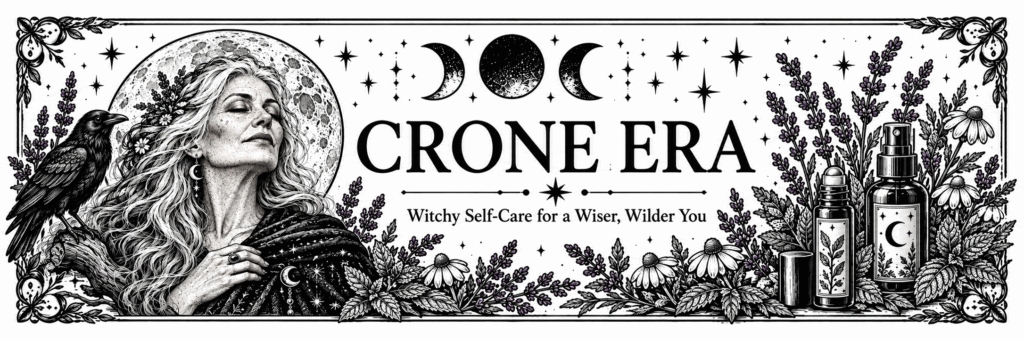
Welcome to your Crone Era.
Not as an insult.
Not as a sad farewell to youth.
But as a reclamation of something that has been misunderstood, feared and dismissed for far too long.
Because the Crone is not simply an old woman in a fairy tale.
In modern witchcraft, she can represent wisdom, experience, independence, transformation and the power of knowing exactly who you are.
And frankly, after everything life has thrown at us, perhaps it’s time we stopped apologising for taking up space.
What Is the Crone in Witchcraft?
In many modern Pagan and witchcraft traditions, the Crone is associated with the third aspect of the Maiden, Mother and Crone archetype.
These three figures are often used to symbolise different phases or qualities of life.
The Maiden represents beginnings, discovery, possibility and independence.
The Mother represents creation, nurturing, responsibility and abundance.
The Crone represents wisdom, experience, endings, transformation and the ability to see beyond appearances.
However, this familiar three-part framework is primarily a feature of modern Pagan spirituality, rather than a universal ancient belief shared by all pre-Christian cultures.
And importantly, these archetypes aren’t biological rules.
You don’t have to become a mother to embody the Mother.
You don’t have to be elderly to connect with the Crone.
And you certainly don’t have to follow a prescribed spiritual journey.
They are symbols that people can interpret and work with in different ways.
For many women, however, the Crone becomes especially meaningful during midlife.
Because something rather interesting happens as we grow older.
We begin to care a little less about what everyone else thinks.
And sometimes, that is where our real freedom begins.
Why Has the Crone Been Feared?
Think about the witches of fairy tales.
The old woman living alone in the woods.
The crooked figure with a cauldron.
The mysterious herbalist.
The woman who knows things other people don’t.
The woman who doesn’t behave as society expects.
She is often presented as frightening, dangerous or wicked.
But look a little closer.
She’s independent.
She understands plants.
She has knowledge.
She lives according to her own rules.
She doesn’t appear particularly interested in pleasing anyone.
Of course, historical depictions of old women and witches are complicated, and not every frightening fairy-tale witch represents a deliberately suppressed wise woman.
But as a modern symbol, the Crone offers something powerful.
She represents a woman who no longer needs permission to be herself.
And perhaps that is why so many of us are beginning to reclaim her.
Menopause: A Transition, Not an Ending
For generations, menopause has often been discussed in whispers.
Something embarrassing.
Something to endure quietly.
Something that apparently marks the beginning of becoming old.
Yet menopause is a natural biological transition, not a personal failure or the end of a woman’s usefulness.
Medically, menopause is reached after 12 consecutive months without a menstrual period, when no other cause explains the absence of periods. The years of hormonal change leading up to it are called perimenopause.
And those changes can affect far more than menstruation.
Hot flushes.
Night sweats.
Sleep disruption.
Brain fog.
Mood changes.
Joint discomfort.
Changes in skin.
Fatigue.
Vaginal dryness.
Changes in confidence.
And sometimes the overwhelming feeling that you’ve suddenly become a stranger inside your own body.
Not everyone experiences all of these symptoms, and some women experience very few.
But for those who struggle, menopause can be genuinely difficult.
You can embrace your Crone Era and still be thoroughly fed up with your symptoms.
Those two things are not mutually exclusive.
There is nothing unspiritual about seeking medical support, including discussing hormone replacement therapy or other evidence-based treatments with a healthcare professional.
And there is certainly nothing magical about suffering unnecessarily.
The Witch Who Is Tired of Being Strong
We often talk about strength in witchcraft.
Personal power.
Resilience.
Transformation.
Taking control of our lives.
But what happens when you’re exhausted?
What happens when your body aches?
When you’ve slept badly for weeks?
When you don’t have the energy to perform an elaborate Full Moon ritual?
When even getting dressed feels like an achievement?
Does that make you less of a witch?
Absolutely not.
There is a tendency within some spiritual communities to present everything as a matter of positive thinking, energy or intention.
As though the right crystal, affirmation or ritual can overcome any physical difficulty.
But chronic illness doesn’t work that way.
Neither does menopause.
And telling someone they simply need to raise their vibration is not helpful when they’re dealing with genuine pain or debilitating fatigue.
You do not have to be well to be worthy.
You do not have to be productive to be powerful.
And you do not have to turn every difficult experience into a spiritual lesson.
Sometimes you’re allowed to be tired.
Sometimes you’re allowed to be angry.
Sometimes you’re allowed to cancel plans, put on comfortable clothes and do absolutely nothing.
That isn’t weakness.
It’s being human.
The Chronic Crone: Witchcraft When Your Body Has Other Plans
There is another side to this conversation that deserves its own space.
Chronic illness.
Fibromyalgia.
Long-term pain.
Fatigue.
The unpredictable good days and bad days.
The frustration of looking perfectly fine on the outside while feeling anything but fine on the inside.
Fibromyalgia, for example, can involve widespread pain, sensitivity, fatigue, disrupted sleep and cognitive difficulties often described as fibro fog. Symptoms can fluctuate considerably from one person to another.
And chronic illness doesn’t politely disappear because there’s a Full Moon.
You might have planned a beautiful ritual.
Candles arranged.
Herbs prepared.
Altar decorated.
And then your body decides that today is a day for staying on the sofa.
That’s okay.
Your magical practice can change with your circumstances.
Low-Energy Witchcraft Is Still Witchcraft
You don’t need to stand for an hour casting a circle.
You don’t need to walk through a forest gathering herbs.
You don’t need to stay awake until midnight.
You can practise witchcraft from your bed.
From your favourite chair.
From the sofa with a blanket and a cup of tea.
Try something small.
Hold a crystal and reflect on its symbolism.
Pull one Tarot card.
Listen to a guided meditation.
Write a sentence in your Book of Shadows.
Light an LED candle.
Look out of the window and notice the Moon.
Or simply rest.
Rest doesn’t have to be earned, and you don’t have to make it magical for it to be worthwhile.
Reclaiming Rest as a Ritual
We’re surrounded by messages telling us to do more.
Be productive.
Improve yourself.
Get organised.
Exercise.
Socialise.
Work harder.
Achieve something.
And even self-care can become another task we’re supposed to complete perfectly.
The elaborate skincare routine.
The hour-long meditation.
The perfectly arranged bath.
The beautifully decorated journal.
But real self-care doesn’t need to look impressive.
Sometimes it looks like recognising your limits.
Sometimes it’s cancelling something.
Sometimes it’s saying no.
Sometimes it’s sitting quietly with a warm drink and allowing yourself twenty minutes without feeling guilty.
For someone living with menopause or chronic illness, small, manageable comforts may be much more realistic than elaborate wellness routines.
And those comforts can become meaningful personal rituals.
Creating Your Own Crone Era Self-Care Rituals
One of the loveliest things about witchcraft is its ability to bring intention into ordinary activities.
You don’t necessarily need a spell.
You don’t need a complicated ceremony.
You can take something simple and make it feel special.
1. The Morning Reset
Mornings can be difficult when you’ve slept badly or wake feeling stiff and exhausted.
Rather than immediately rushing into the day, create a small moment for yourself.
Open the curtains.
Notice the light.
Make your favourite drink.
Sit quietly for a few minutes.
You might say:
“Today I will work with the energy I have, not the energy I wish I had.”
If you enjoy herbal teas, preparing a cup can become part of that morning ritual.
Choose something you enjoy drinking, check that the ingredients are suitable for you, and allow yourself a moment of peace.
Roaming Raven collection connection: Chronic Crone Uplifting Herbal Tea and Energise Pulse Roller. Present these as sensory or ritual companions, not treatments for fatigue.
2. The Cooling Crone Ritual
For some women, menopause seems to involve an internal thermostat with a particularly wicked sense of humour.
One minute you’re perfectly comfortable.
The next you’re wondering whether removing every item of clothing would be socially acceptable.
Practical cooling measures can include lightweight clothing, a cooler bedroom, a fan, a cool shower or a cold drink.
You can also create a refreshing personal ritual.
Take a moment away from whatever you’re doing.
Find somewhere comfortable.
Cool down.
Breathe.
Allow yourself a few minutes without rushing.
A pleasantly scented mist or pulse-point fragrance may add a sensory element to the routine, provided it is suitable for your skin and used as directed.
Roaming Raven collection connection: Crone Era Cooling Face Mist and Cooling Pulse Roller. Avoid claiming that these products medically relieve hot flushes or regulate body temperature.
3. The Evening Wind-Down
Sleep can become particularly frustrating during menopause and for people living with fibromyalgia.
You may be tired all day, only to discover that your brain has decided midnight is the perfect time to revisit every conversation you’ve had since 1997.
A simple bedtime routine might include:
Lowering the lights.
Putting your phone aside.
Taking a comfortable shower.
Listening to quiet music.
Reading a few pages of a book.
Keeping the bedroom cool and comfortable.
You might incorporate a favourite fragrance or a small sleep-themed sachet beside your bed.
Not because it guarantees sleep, but because familiar routines and pleasant sensory associations can make bedtime feel more peaceful.
Roaming Raven collection connection: Crone Era Sleep Sachet, Lavender Shower Steamers and Crone Era Gift Box.
4. The Five-Minute Shower Ritual
Not everyone has a bathtub.
And not everyone has the energy for an elaborate bathing ritual.
Sometimes a shower is all you can manage.
But it can still become a moment of intention.
As the water runs, imagine the day’s worries being washed away.
You might quietly say:
“I release what I cannot carry today. I keep what gives me strength.”
Enjoy the fragrance of a shower steamer if you tolerate scented products.
Then step out, dry yourself and continue your day.
No complicated spellwork required.
Roaming Raven collection connection: Crone Era Shower Steamers in Lemon, Lavender and Clary Sage, and Chronic Crone Shower Steamers with Grapefruit, Bergamot, Rosemary and Lemon Verbena.
Crystals, Symbolism and the Crone
Crystals have become an important part of many modern witchcraft practices.
While there is no good scientific evidence that crystals treat menopause, fibromyalgia or chronic pain, their symbolic associations can still have personal meaning.
You might choose a stone to represent a quality you want to cultivate.
Amethyst is often associated in modern crystal spirituality with calm, reflection and intuition.
Green Jasper is commonly connected with grounding, steadiness and the natural world.
Moonstone is frequently associated with cycles, transitions and feminine symbolism.
Black Tourmaline is often used symbolically for protection and boundaries.
Holding a crystal during meditation or keeping one nearby can serve as a physical reminder of your intention.
Perhaps your amethyst bracelet reminds you to slow down.
Perhaps your jasper bracelet reminds you that you’re allowed to set boundaries.
The power of that reminder doesn’t depend on a crystal having medical properties.
It depends on the meaning you give it.
Roaming Raven collection connection: Chronic Crone Amethyst and Green Jasper Bracelets.
The Crone and the Art of Saying No
There is one magical skill that deserves considerably more attention.
Boundaries.
Not every spell needs candles and herbs.
Sometimes the most powerful thing you can say is:
“No, I can’t do that.”
Without an apology.
Without a ten-minute explanation.
Without feeling obliged to make everyone else comfortable.
Midlife can be a time when we begin to reconsider the expectations we’ve carried for years.
The pressure to be endlessly available.
To look a certain way.
To put everyone else first.
To pretend we’re fine.
To keep going even when we’re exhausted.
The Crone archetype offers a different possibility.
A woman who knows her limits.
A woman who understands her worth.
A woman who no longer confuses being needed with being valued.
And perhaps most importantly, a woman who realises that protecting her peace is not selfish.
It’s necessary.
A Simple Crone Era Empowerment Ritual
This is a gentle ritual for anyone embracing a new chapter of life.
It doesn’t require much energy or preparation.
You will need: a candle or LED candle, a piece of paper, a pen and somewhere comfortable to sit.
Step One: Reflect
Think about the expectations you’ve carried throughout your life.
What have you been told a woman should be?
What have you felt obliged to do?
What no longer feels right?
Step Two: Write
On your paper, finish this sentence:
“I am no longer willing to…”
Write whatever comes to mind.
Perhaps:
Apologise for needing rest.
Feel ashamed of getting older.
Say yes when I mean no.
Judge my body for changing.
Pretend I’m coping when I need help.
Step Three: Reclaim
Turn the paper over.
Write:
“In this chapter of my life, I choose…”
Perhaps:
Peace.
Confidence.
Comfort.
Wisdom.
Authenticity.
Better boundaries.
More joy.
Step Four: Set Your Intention
Light your candle safely, or switch on your LED candle.
Say:
“I honour the woman I have been.
I welcome the woman I am becoming.
I release the expectations that no longer belong to me.
My wisdom is earned.
My boundaries are sacred.
My life is still unfolding.”
Sit quietly for a moment.
Keep the second side of your paper somewhere meaningful.
You might tuck it into your Book of Shadows or place it beside your mirror.
And when you need reminding, read it again.
Chronic Illness, Grief and the Body We Used to Have
One aspect of chronic illness that isn’t always discussed is grief.
Not necessarily grief for another person.
But grief for the version of yourself you remember.
The person who could stay out all evening.
Walk for miles.
Make spontaneous plans.
Get through a busy day without thinking about the consequences.
When your health changes, you may find yourself missing things you once took for granted.
And that’s understandable.
You can be grateful for the life you have while still grieving what has changed.
You can find meaning in your experiences without pretending they’re wonderful.
You can adapt your witchcraft without celebrating the limitations that made adaptation necessary.
The Crone doesn’t have to be endlessly serene and accepting.
She can be frustrated.
She can be angry.
She can be sad.
She can have a thoroughly miserable Tuesday.
Wisdom isn’t the absence of difficult emotions.
Sometimes wisdom is recognising them without judging yourself for having them.
Why We Created the Crone Era and Chronic Crone Collections
Here at Roaming Raven, we wanted to create something that reflected this stage of life a little differently.
Something witchy.
Something practical.
Something with humour.
Something that acknowledged that midlife, menopause and chronic illness aren’t always particularly glamorous.
But also something that celebrated the women experiencing them.
That’s how our Crone Era and Chronic Crone collections came about.
Not as miracle cures.
Not as medical treatments.
And certainly not as a suggestion that a scented roller or crystal bracelet can resolve complex health conditions.
Instead, we wanted to create small, thoughtful products that could become part of everyday moments of comfort, personal ritual and self-care.
The Crone Era collection celebrates women navigating menopause and midlife.
The Chronic Crone collection was created with people living with fibromyalgia, chronic illness, fatigue and unpredictable energy in mind.
From fragrant shower steamers and pulse rollers to herbal teas, symbolic gemstone jewellery and gift boxes, each product is intended to bring a little witchy character to ordinary routines.
Because sometimes the smallest comforts matter.
And sometimes it’s nice to receive a gift that says:
“I see you. I know things aren’t always easy. And you deserve something lovely.”
Thoughtful Gifts for the Crone in Your Life
Buying gifts for someone going through menopause or living with chronic illness can be surprisingly difficult.
You don’t necessarily want to give them something that makes their condition the centre of attention.
You don’t want to imply that they need fixing.
And you certainly don’t want to buy something promising miraculous results.
Sometimes a thoughtful gift is simply an invitation to enjoy a little comfort.
A beautiful herbal tea.
A bracelet with meaningful symbolism.
A scented shower ritual.
A carefully chosen gift box.
A little reminder that they’re valued.
Our Crone Era and Chronic Crone gift boxes bring together several of these small rituals in one place.
They’re designed as gifts of appreciation and everyday enjoyment, not medical solutions.
Because the woman receiving the gift deserves celebrating—not fixing.
You Don’t Have to Earn Your Crone Era
Perhaps you’re fifty-five.
Perhaps you’re forty.
Perhaps you’re older.
Perhaps menopause arrived early.
Perhaps you’re not menopausal at all but feel deeply connected with the symbolism of the Crone.
That’s fine.
You don’t need a particular birthday.
You don’t need grey hair.
You don’t need grandchildren.
You don’t need a cauldron, although admittedly a good cauldron never hurts.
And you certainly don’t need to have all the answers.
The Crone isn’t a prize awarded for reaching a certain age.
She’s an archetype you can choose to explore.
A reminder that experience has value.
That change is part of life.
That wisdom doesn’t always arrive neatly.
And that the next chapter can belong to you.
Frequently Asked Questions About the Crone Era
What does entering your Crone Era mean?
In modern witchcraft, entering your Crone Era often means embracing wisdom, experience, independence and personal transformation. Many people connect it with midlife or menopause, although there is no required age or biological milestone.
Is the Crone associated with menopause?
The Crone is frequently associated with later life and menopause in modern Pagan symbolism. However, the connection is symbolic rather than a medical or universal spiritual rule.
What is the Maiden, Mother and Crone?
The Maiden, Mother and Crone are three archetypes used in some modern Pagan traditions to represent different qualities or stages of life, including beginnings, creation, experience and wisdom.
Can you practise witchcraft with fibromyalgia or chronic illness?
Absolutely. Witchcraft can be adapted to individual abilities and energy levels. Short meditations, seated rituals, journalling, divination and symbolic practices can all be done without elaborate physical activity.
What is low-energy witchcraft?
Low-energy witchcraft is an informal term for adapting magical practices to require less physical or mental effort. It can be especially useful for people experiencing fatigue, pain, disability or illness.
Can crystals help with menopause or fibromyalgia?
There is no reliable scientific evidence that crystals treat these conditions. However, people may enjoy them as symbolic objects, jewellery or personal reminders of intentions.
Are herbal remedies safe during menopause?
Not necessarily. Herbal products can have side effects and interact with medicines. The NHS recommends speaking with a healthcare professional before taking herbal supplements or complementary medicines for menopause symptoms.
Is self-care enough to manage fibromyalgia?
No. Self-care and relaxation may be useful alongside appropriate treatment, but fibromyalgia can require medical assessment and an individualised management plan. The NHS describes options including suitably adapted activity, talking therapies and medication.
What is the Chronic Crone collection?
Chronic Crone is a Roaming Raven collection of witchy self-care gifts and accessories created with people living with fibromyalgia and chronic illness in mind. It focuses on enjoyable personal rituals, symbolism and thoughtful gifts rather than treating medical conditions.
Final Thoughts: The Crone Has Entered the Room
Perhaps we’ve spent too long being afraid of becoming the Crone.
Afraid of wrinkles.
Afraid of ageing.
Afraid of becoming invisible.
Afraid that the best parts of our lives are behind us.
But what if we’ve misunderstood her?
What if the Crone isn’t the woman whose story is ending?
What if she’s the woman who has finally realised that she gets to write the next chapter herself?
She’s lived.
She’s learned.
She’s loved.
She’s lost.
She’s made mistakes.
She’s survived things she never expected to face.
And now?
Perhaps she wants a little peace.
Perhaps she wants adventure.
Perhaps she wants to start something completely new.
Perhaps she wants to sit in her garden, drink tea and tell everyone to leave her alone for an afternoon.
All perfectly reasonable ambitions.
And for those of us navigating menopause, chronic illness or bodies that don’t always cooperate, perhaps the Crone offers one particularly important reminder:
Our value was never measured by how much we could do.
Not by how young we looked.
Not by how productive we were.
Not by how much we gave to everyone else.
And not by how successfully we pretended everything was fine.
We are allowed to change.
We are allowed to rest.
We are allowed to take up space.
We are allowed to be complicated, imperfect, tired, joyful, frustrated, wise and occasionally rather unreasonable.
We are allowed to grow older without becoming smaller.
So here’s to the Crone.
The wise woman.
The stubborn woman.
The woman who has had quite enough of everyone else’s nonsense.
The woman who is still discovering herself.
May her tea always be warm, her boundaries strong, and her tolerance for nonsense gloriously low.
Welcome to your Crone Era.
The magic isn’t over.
It’s simply changing.