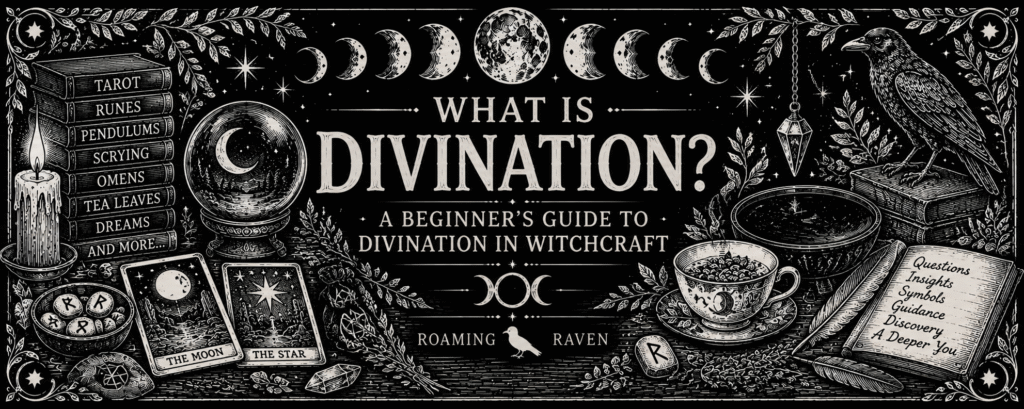
A Tarot card turns over.
A pendulum begins to swing.
Runes tumble onto a cloth.
Shapes slowly appear in the dark surface of a scrying mirror.
For centuries, people have looked for ways to seek guidance, interpret signs and explore questions about things they cannot easily know.
We call this divination.
Today, divination is strongly associated with witchcraft, Tarot cards and fortune telling—but its history is far older and much broader than modern witchcraft.
Ancient societies observed birds, stars, dreams, lots, bones, fire, water and countless other things in an attempt to understand divine will, predict events or make important decisions.
Modern practitioners continue to use an extraordinary variety of divination methods.
But does divination really mean predicting the future?
Not necessarily.
For many modern witches, divination is less about discovering exactly what will happen and more about asking questions, exploring possibilities and examining situations from a different perspective.
So let’s explore what divination actually is, where it comes from and some of the most popular methods you can try.
What Does Divination Mean?
Divination is a broad term for practices intended to gain insight or knowledge through interpreting signs, symbols, patterns or other methods.
Historically, divination was often connected with gods, spirits or supernatural forces.
People might seek answers about:
- War
- Harvests
- Marriage
- Journeys
- Illness
- Political decisions
- Weather
- Religious matters
Today, someone might consult a divination tool about:
- Relationships
- Work
- Personal decisions
- Spiritual practice
- Creativity
- Emotional patterns
- Future possibilities
The questions have changed somewhat.
The human desire for guidance hasn’t.
Is Divination the Same as Fortune Telling?
The terms overlap, but they aren’t necessarily identical.
Fortune telling usually implies attempting to predict future events.
Divination can be much broader.
You might ask Tarot:
“What should I consider before making this decision?”
rather than:
“What exactly will happen?”
Or:
“What am I overlooking in this situation?”
rather than:
“Tell me my future.”
For many practitioners, this makes divination less about fixed destiny and more about reflection and possibility.
Can Divination Predict the Future?
There is no reliable scientific evidence showing that divination methods can consistently predict future events through supernatural means.
That doesn’t mean divination cannot be meaningful.
A Tarot spread, for example, may present symbols that encourage you to consider a situation differently.
A journalling session after a rune reading might reveal something you’ve been avoiding.
A pendulum ritual may give you a structured moment to think carefully about a choice.
Some practitioners interpret these experiences spiritually.
Others see them psychologically.
And many probably occupy somewhere between the two.
What matters is remembering that divination should not remove your ability to make your own decisions.
A Brief History of Divination
Humans have practised forms of divination for thousands of years.
Ancient Mesopotamian societies developed sophisticated systems for interpreting omens.
Divination was also practised in ancient Egypt, Greece and Rome.
The Greeks consulted famous oracles, while Roman religious officials interpreted signs including the behaviour of birds.
Chinese divination traditions include the I Ching, whose history extends back thousands of years.
Across different cultures, people have interpreted:
- Stars
- Dreams
- Animal behaviour
- Bones
- Lots
- Fire
- Water
- Entrails
- Natural phenomena
There was never one universal system called “divination.”
Instead, cultures developed their own methods for seeking information beyond ordinary observation.
Divination in Modern Witchcraft
Modern witches may incorporate divination into their practice in many ways.
Some perform a daily Tarot pull.
Others consult runes.
Some use pendulums.
Others practise scrying.
Divination might be used:
Before spellwork.
During a Full Moon ritual.
At a Sabbat.
When beginning a new month.
During shadow work.
When reflecting on a decision.
Or simply because pulling a Tarot card with your morning tea has become part of your routine.
There is no requirement to practise divination in order to be a witch.
And you don’t have to be a witch to practise divination.
Tarot Cards
Tarot is probably the most recognisable divination system in modern Western spirituality.
A standard Tarot deck contains 78 cards divided into:
22 Major Arcana
and
56 Minor Arcana
But Tarot wasn’t originally created for fortune telling.
Its earliest forms developed in fifteenth-century Europe as playing cards.
The association between Tarot and occult divination developed considerably later, particularly from the eighteenth century onwards.
Today Tarot is used for:
- Divination
- Reflection
- Meditation
- Journalling
- Storytelling
- Shadow work
- Creative inspiration
How Does Tarot Work?
That depends on who you ask.
A spiritual practitioner might believe intuition, spirit or synchronicity influences which cards appear.
Someone else may see Tarot as a psychological prompt.
Imagine asking:
“Why am I struggling with this project?”
You draw a card depicting isolation.
Perhaps your immediate reaction is:
Actually, I’ve been trying to do everything myself.
Did the card magically know?
Was it coincidence?
Or did the image simply give your mind a new route into the problem?
Different practitioners will answer differently.
You don’t necessarily have to settle the question before Tarot can be useful to you.
Oracle Cards
Oracle decks are often confused with Tarot.
The major difference is structure.
Tarot generally follows the recognisable 78-card system.
Oracle decks don’t.
An oracle deck might contain:
30 cards.
44 cards.
60 cards.
Or almost any number the creator chooses.
Its themes might include:
- Animals
- Herbs
- Goddesses
- Moon phases
- Affirmations
- Spirits
- Seasons
Oracle decks are often particularly approachable for beginners because you don’t need to learn Tarot’s established structure.
Pendulum Divination
A pendulum is a weighted object suspended from a chain or cord.
During divination, the practitioner asks questions and interprets the pendulum’s movement.
For example:
Back and forth = Yes.
Side to side = No.
Circle = Unsure.
However, you should establish your own movement meanings before beginning rather than assuming every pendulum behaves according to the same rules.
How Does a Pendulum Move?
This is fascinating.
Small unconscious muscular movements can cause a pendulum to move without the person consciously intending to move their hand.
This is known as the ideomotor effect.
The same phenomenon helps explain movement in other practices involving apparently autonomous physical responses.
A spiritual practitioner may interpret pendulum movement differently.
But understanding the ideomotor effect is useful because it reminds us not to treat a pendulum as an infallible external authority.
What Should You Ask a Pendulum?
Pendulums work best with questions that can be answered simply.
For example:
“Would it benefit me to work on this project today?”
rather than:
“What should I do with my entire career?”
And avoid repeatedly asking the same question until you receive the answer you wanted.
At that point, you’re no longer seeking guidance.
You’re negotiating with a bead on a chain.
Rune Divination
Runes are another extremely popular form of divination.
But historically, runes were first and foremost letters.
Germanic peoples used several runic alphabets.
The best-known today is the Elder Futhark, containing 24 characters.
Modern rune divination usually involves drawing or casting rune stones and interpreting their symbolic meanings.
There is historical evidence for magical and divinatory uses of runes and related practices, but many detailed rune-reading systems used today are modern developments.
That distinction is important.
History gives us a foundation.
Modern practice adds layers to it.
How to Use Runes for Divination
The simplest beginner method is drawing one rune.
Ask:
“What should I reflect upon today?”
Mix your runes in a bag.
Choose one.
Look at:
- The rune itself
- Its name
- Historical meaning
- Modern interpretations
- Your immediate reaction
Record it in your journal.
Over time, you’ll become familiar with the rune system without trying to memorise 24 meanings overnight.
Scrying
Scrying involves gazing into a surface or object and observing images, impressions or patterns.
You may have heard of:
Crystal ball gazing.
That’s scrying.
But crystal balls are only one method.
People also scry using:
- Black mirrors
- Water
- Fire
- Smoke
- Crystals
- Reflective surfaces
Rather than forcing yourself to “see a vision,” the practitioner generally adopts a relaxed gaze and observes whatever impressions arise.
Black Mirror Scrying
A black mirror provides a dark reflective surface.
Sit somewhere comfortable with gentle lighting.
Place the mirror where you’re not staring directly at a bright reflection.
Relax your gaze.
Don’t strain.
You may notice:
Shapes.
Patterns.
Images.
Memories.
Thoughts.
Or absolutely nothing.
That’s fine.
Scrying is a practice, not an instant supernatural television screen.
Fire Scrying
Humans have stared into fires for an extraordinarily long time.
Flames constantly change.
Shapes appear and disappear.
This makes fire naturally suited to contemplative practices.
A practitioner might observe:
- Flame movement
- Shapes
- Colours
- Patterns
- Personal impressions
However, avoid turning every flicker into an omen.
Candles respond to perfectly ordinary things including air movement, wick length and wax.
Sometimes a dancing flame means:
there’s a draught.
Water Scrying
Water is another traditional reflective surface.
You can use a dark bowl filled with water.
Sit somewhere quiet.
Allow the surface to become still.
Gaze softly into it.
Notice thoughts, images or associations that arise.
You don’t need to add herbs, oils or anything else.
Plain water works perfectly well.
Tea Leaf Reading
Tea-leaf reading is usually called tasseography or tasseomancy.
Loose tea leaves remain inside the cup after drinking.
The reader examines the patterns left behind and interprets the shapes.
A bird might suggest one thing.
A circle another.
A road another.
Interpretation systems vary enormously, and personal association often plays a large role.
It’s an excellent example of divination transforming an ordinary activity into ritual.
Drink tea.
Look at the leaves.
Find stories in the shapes.
Very witchy.
Very economical.
Bibliomancy
Bibliomancy involves using a book for divination.
Traditionally, sacred or significant texts have sometimes been used.
A simple modern version involves:
Choose a book.
Hold your question in mind.
Open it at random.
Allow your attention to fall on a passage.
Then consider how those words relate to your question.
Does the book contain supernatural knowledge about your situation?
Probably not.
Can an unexpected sentence make you consider something differently?
Absolutely.
Dream Divination
Dreams have been interpreted as meaningful messages across many cultures and historical periods.
Modern witches may keep dream journals and look for:
- Repeating themes
- Symbols
- People
- Animals
- Places
- Emotions
But be careful with universal dream dictionaries.
A snake does not automatically mean exactly the same thing for everyone.
If you’re terrified of snakes, your association differs considerably from someone who keeps snakes as pets.
Personal context matters.
Bone Casting and Casting Lots
Casting objects and interpreting how they fall is another ancient type of divination.
Modern practitioners may use collections containing:
- Bones
- Shells
- Stones
- Coins
- Charms
- Buttons
- Keys
Each object may have an assigned meaning.
The reader casts them onto a cloth or surface and interprets their positions and relationships.
This can become an incredibly personal divination system.
Dice Divination
Yes—ordinary dice can be used for divination.
This practice is sometimes called astragalomancy, although historically the objects used could include knucklebones rather than modern dice.
You might assign meanings to numbers and roll one or more dice.
It is simple, portable and requires no expensive equipment.
Your witchcraft starter kit may already be sitting inside the Monopoly box.
Coin Divination
The simplest form?
Heads or tails.
Humans have used random outcomes to make decisions for centuries.
Interestingly, sometimes the most revealing part isn’t the result.
It’s your reaction.
You flip the coin.
It lands on tails.
And immediately you think:
Oh. I was hoping it would be heads.
You may already have discovered your answer.
Automatic Writing
Automatic writing involves writing with as little conscious planning as possible.
Some spiritual practitioners interpret the resulting words as communication from spirits or the subconscious.
From a more psychological perspective, free-flow writing can allow unexpected thoughts and associations to emerge.
Either way, avoid assuming that anything written automatically must represent an external supernatural message.
Signs and Omens
This is an area where discernment becomes particularly important.
You see three ravens.
A feather appears outside your door.
The same number keeps appearing.
A candle goes out.
Is it a sign?
Maybe it has personal meaning.
But first consider the ordinary explanation.
Birds behave like birds.
Feathers fall from them.
Algorithms repeatedly show us similar content.
Candles go out.
Not every coincidence requires supernatural interpretation.
A useful practice is to ask:
Why did this particular thing feel meaningful to me?
That question is often more valuable than searching Google for a universal answer.
How to Choose a Divination Method
Don’t buy every divination tool you see.
Start with the method that genuinely interests you.
If you love imagery and storytelling:
Try Tarot.
If you like simple yes/no questions:
Try a pendulum.
If you love history and symbolism:
Explore runes.
If you’re visually imaginative:
Try scrying.
If you love tea:
Try tasseography.
If you love journalling:
Try bibliomancy or dream work.
Your preferred divination method may be the one you actually enjoy practising.
Do You Need Psychic Ability to Practise Divination?
No.
You don’t need to identify as psychic.
Many divination systems involve skills that can be learned:
- Symbol interpretation
- Observation
- Pattern recognition
- Reflection
- Familiarity with a system
- Intuition
A beginner Tarot reader isn’t expected to know every card instantly.
You learn gradually.
The same applies to runes and other systems.
What Is Intuition?
The word intuition appears constantly in divination.
In ordinary terms, intuition can describe understanding or judgement that arises without deliberate conscious reasoning.
Our brains continuously process information outside our immediate awareness.
Sometimes we experience the result as:
“I just have a feeling.”
That doesn’t mean every intuitive feeling is correct.
Bias, fear, expectation and previous experience can all influence intuition.
This is why discernment matters.
Divination and Confirmation Bias
Suppose you desperately want a particular answer.
You draw Tarot cards until one finally seems positive.
Then you stop.
That’s a perfect example of why divination needs self-awareness.
Confirmation bias describes our tendency to notice or favour information that supports what we already believe or want to believe.
Divination systems are especially vulnerable because symbols can often support several interpretations.
A useful habit is to ask:
“Would I interpret this differently if I wanted the opposite answer?”
That’s an excellent question to write in your Book of Shadows.
Questions to Avoid Asking Divination Tools
Divination should not replace expert advice or evidence in high-stakes situations.
Don’t rely on Tarot, pendulums or runes to decide:
- Whether you need medical treatment
- Whether medication is safe
- Whether someone has committed a crime
- Whether someone is secretly dangerous
- Major financial investments
- Legal decisions
Use appropriate professional advice and real-world evidence.
Your cards can help you reflect on how you feel about a situation.
They cannot diagnose illness or establish facts about another person.
Asking Better Divination Questions
Instead of:
“Will I get the job?”
Try:
“What can I do to prepare well for this opportunity?”
Instead of:
“Does this person love me?”
Try:
“What should I pay attention to in this relationship?”
Instead of:
“Will my business succeed?”
Try:
“Where should I focus my efforts in my business right now?”
The second type of question gives you something useful to work with.
A Simple Divination Ritual for Beginners
Choose one tool.
We’ll use Tarot as an example.
Step 1: Ground
Sit comfortably.
Take several breaths.
Put your phone away.
Step 2: Ask One Question
Try:
“What would be useful for me to reflect upon today?”
Step 3: Draw One Card
Don’t immediately search for the meaning.
Look first.
What do you notice?
Step 4: Record Your Reaction
Write down:
- The card
- What caught your attention
- How it made you feel
- What you think it might mean
Step 5: Research
Now consult a reliable guidebook.
Compare the traditional interpretation with your first impression.
Step 6: Take Something Practical From It
Ask:
“Is there anything useful I can do with this insight?”
Then close the reading.
That’s a complete divination practice.
Keeping a Divination Journal
This is one of the best ways to improve.
Record:
Date
Question
Method
Cards/runes/results
Your interpretation
What actually happened later
That last section is particularly valuable.
Memory is unreliable.
We tend to remember impressive “hits” and forget the many readings that didn’t seem relevant.
Written records allow you to look back more objectively.
Add Divination to Your Book of Shadows
You might create sections for:
- Tarot meanings
- Rune meanings
- Pendulum charts
- Scrying notes
- Dream symbols
- Spreads
- Questions
- Reading records
- Personal correspondences
Over time, you’ll create something much more useful than a generic divination guide.
You’ll have a record of how you actually practise.
Should You Cleanse Divination Tools?
Some practitioners like to cleanse Tarot cards, runes or pendulums.
Methods might include:
- Sound
- Moonlight
- Visualisation
- Simply tidying and resetting the deck
This is optional.
There is no evidence that Tarot cards physically absorb “negative energy.”
But if cleansing marks the beginning or end of your practice, it can still be a meaningful ritual.
Avoid methods that could damage your tools.
Your Tarot deck does not need a salt bath.
Please don’t do that.
Do You Need to Protect Yourself Before Divination?
Not necessarily.
Some practitioners incorporate protection or circle casting before divination, particularly when their spiritual beliefs involve spirit communication.
Others simply sit down and read their cards.
You can choose a practice appropriate to your beliefs.
If you enjoy creating formal ritual space, see our guide to How to Cast a Circle in Witchcraft.
Can You Read Tarot for Yourself?
Absolutely.
The main difficulty isn’t magical.
It’s objectivity.
When you’re emotionally invested in the answer, it becomes easier to interpret ambiguous symbols in the way you want.
Writing your interpretation down before reaching for extra cards can help.
And sometimes the wisest reading is:
“I’m too emotionally involved in this question today.”
Put the deck away.
Try again later.
Frequently Asked Questions About Divination
What is divination in witchcraft?
Divination is the practice of using symbols, tools, signs or structured methods to seek insight or guidance. Modern witches may use Tarot, runes, pendulums, scrying and many other methods.
Is Tarot a form of divination?
Yes. Tarot is one of the most popular modern Western divination systems.
What is the easiest divination method for beginners?
There isn’t one universal best method. Single-card Tarot readings, oracle cards, pendulums and simple rune draws are all accessible starting points.
Can anyone practise divination?
Yes. You don’t need to identify as psychic or as a witch to learn a divination system.
Is a pendulum accurate?
Pendulum movement can be influenced by unconscious muscular movements known as the ideomotor effect, so it shouldn’t be treated as an objective source of factual information.
Can divination tell me exactly what will happen?
There is no reliable evidence that divination consistently predicts future events. It can instead be approached as a tool for reflection, symbolism and exploring possibilities.
Do I need to cleanse Tarot cards?
No. Some practitioners enjoy cleansing as part of ritual, but it isn’t required.
Can I use more than one form of divination?
Absolutely. Many practitioners use several systems and choose whichever best suits the question or occasion.
Final Thoughts: Divination Is a Conversation, Not a Command
Perhaps the most useful way to approach divination is not:
“Tell me what is going to happen.”
But:
“Show me something I haven’t considered.”
That small change transforms the practice.
A Tarot card no longer controls your future.
A pendulum doesn’t make your decisions.
A rune doesn’t tell you what you must do.
Instead, they create a conversation.
Between symbol and interpretation.
Between question and possibility.
Between the part of you asking for an answer and the part of you that may already know more than you realise.
Humans have always searched for patterns.
In stars.
In birds.
In dreams.
In cards.
In fire.
In the shapes left at the bottom of a teacup.
Perhaps sometimes we believed those patterns came from gods or spirits.
Sometimes we simply found meaning in them.
And perhaps that’s why divination has survived for thousands of years.
Not because humans stopped being uncertain.
But because we never stopped asking questions.