“A spell becomes far more useful when you can remember not only what you did, but why you did it, what happened afterwards, and what you learned from the experience.”

Introduction

Many witches record spells.
Far fewer record them in a way that actually helps them learn.
It is easy to write:

Protection Spell
Black candle
Rosemary
Salt
Light candle and visualise protection.

That may be enough to recreate the ritual.
But it tells you almost nothing about:
  • Why those ingredients were chosen
  • What you were trying to achieve
  • What your emotional state was
  • Whether you changed the method
  • What happened afterwards
  • Whether the result matched the original intention
  • What you would do differently next time
A useful Book of Shadows should do more than preserve spell instructions.
It should help you develop discernment, consistency and reflection.
This means recording magical practice in a way that separates:
  • What you intended
  • What you actually did
  • What you observed
  • What you interpreted
  • What happened later
That distinction matters.
Without it, memory can become unreliable.
We remember the successful parts.
We forget the uncertain outcomes.
We quietly change what we think we originally intended.
We notice coincidences after the ritual and convince ourselves they were exactly what we asked for.
A good magical record protects you from that.
In this chapter, you will learn how to record spells and rituals in a way that is:
  • Clear
  • Practical
  • Honest
  • Repeatable
  • Personal
  • Useful over time
You will also explore:
  • The difference between spells and rituals
  • Recording intentions properly
  • Ingredient and correspondence notes
  • Timing
  • Practical action
  • Emotional state
  • Ritual structure
  • Outcomes
  • Unsuccessful workings
  • Repeating spells
  • Ethical notes
  • Privacy
  • Adaptations
  • Confirmation bias
  • Building your own magical method
The aim is not to make witchcraft clinical.
It is to help you learn from your own practice rather than relying entirely on memory.

What Is a Spell?

There is no single universal definition used by every tradition.
Within modern witchcraft, a spell is often understood as:

A deliberate magical working designed around a specific intention.

It may involve:
  • Words
  • Candles
  • Herbs
  • Symbols
  • Knots
  • Sigils
  • Petition papers
  • Charms
  • Stones
  • Oils
  • Movement
  • Meditation
  • Prayer
  • Visualisation
Or it may involve almost none of these.
A spell can be extremely simple.
For example:
  • Writing an intention and burning the paper safely
  • Tying a knot while speaking a boundary
  • Lighting a candle before beginning an important task
  • Carrying a symbolic charm
The objects are not what automatically make something a spell.
The deliberate magical intention and method are central.

What Is a Ritual?

A ritual is usually broader.
A ritual may:
  • Mark a transition
  • Honour a deity
  • Celebrate a season
  • Open sacred space
  • Close sacred space
  • Support meditation
  • Contain several spells
  • Be devotional rather than goal-focused
For example:
A Samhain ritual might include:
  • Cleansing
  • An altar
  • An ancestor acknowledgement
  • Divination
  • A candle spell
  • Closing words
The candle spell is one part of the ritual.
This distinction is useful in your Book of Shadows because the records may need different structures.

A Spell Is Not Automatically a Ritual

Likewise, a ritual does not necessarily contain spellwork.
You may have a ritual consisting only of:
  • Lighting a candle
  • Reading a poem
  • Offering water
  • Sitting quietly
with no intention to change an outcome.
That can still be meaningful ritual practice.

Why Record Spellwork?

There are several good reasons.
To remember
You may want to repeat the working later.
To improve
You can identify which parts were useful.
To compare
Repeated workings may reveal patterns.
To preserve originality
If you adapt a spell, you can remember what changed.
To challenge memory
Your written record tells you what you actually asked for.
To reduce confirmation bias
You can compare the result with the original goal.
To build your own practice
Over time, you begin to see what methods genuinely suit you.
This is where a Book of Shadows becomes especially valuable.

Date Every Working

Always record the date.
That allows you to compare:
  • Moon phase
  • Season
  • Emotional state
  • Later outcomes
  • Repeated rituals
It also helps you understand how your practice changes over time.
You may look back years later and realise:

“I used to use five ingredients for everything. Now I use one.”

That is development.

Record the Intention Before the Spell

Do this before the working begins.
Not afterwards.
Your intention should be specific enough to evaluate.
Instead of:

Prosperity

write:

To support my goal of earning an additional £300 through new work during the next month.

Instead of:

Protection

write:

To reinforce my boundaries and help me feel secure while dealing with a difficult workplace situation.

The clearer the intention, the more useful the later reflection becomes.

Avoid Impossible Precision

A clear intention does not need to become an obsessive legal contract.
There is a balance.
Too vague:

“Bring good things.”

Too rigid:

“At exactly 10:13 on Friday, X person must call me and offer £437.21.”

A useful intention describes:
  • The desired direction
  • The context
  • The timeframe if relevant
without attempting to control every variable.

Intention Versus Goal

It can be useful to separate these.
Goal
The practical outcome.

“I want to secure employment.”

Magical intention
What the ritual symbolically supports.

“Confidence, opportunity and clarity during my job search.”

That distinction helps you combine magic with practical action.

Practical Action Should Be Recorded

This is one of the most important sections in your spell record.
Ask:

What am I doing in ordinary life to support this intention?

A job spell might accompany:
  • Updating your CV
  • Applying for jobs
  • Contacting people
  • Preparing for interviews
A protection ritual may accompany:
  • Changing passwords
  • Setting boundaries
  • Installing locks
  • Seeking support
A prosperity spell may accompany:
  • Budgeting
  • Marketing
  • Creating products
  • Contacting customers
Magical practice works best when it does not replace practical action.

Record the Source

Where did the spell come from?
Possible categories:
Original
You created it yourself.
Adapted
You changed an existing spell.
Traditional
The working comes from a particular documented tradition.
Modern source
A book, website or contemporary practitioner.
Record:
  • Author
  • Book
  • Page
  • Website
  • Date accessed
If you change the spell, note exactly what you changed.

Why Source Matters

Suppose years later you find:

“Burn rosemary and bay on Tuesday for protection.”

You may wonder:
  • Did I create this?
  • Did it come from a book?
  • Was it historical?
  • Was Tuesday originally part of it?
Without the source, you cannot tell.
A simple note solves this.

Record the Ingredients

List everything.
For example:
Candle: Black taper
Herb: Rosemary
Paper: Petition
Ink: Black
Oil: Ritual oil
Other: Small bowl of water
This may seem obvious.
But detailed records become useful when you later ask:
“What was different the second time?”

Record Why Each Ingredient Was Chosen

This is even more useful.
For example:
Rosemary
Chosen for protection and remembrance of personal boundaries.
Black candle
Chosen for banishing and boundary symbolism.
Water
Used as a symbol of emotional release.
Now the ritual has logic.
You are not merely copying ingredients.

Correspondence Notes

For each major ingredient, you may record:
Correspondence type:
  • Historical
  • Folklore
  • Modern magical
  • Personal
For example:

Rosemary — modern protection correspondence + personal association with home.

This helps you understand why a ritual feels coherent to you.

Do Not Add Ingredients Just to Make a Spell Look Impressive

A spell with:
  • Nine herbs
  • Three crystals
  • Five oils
  • Two candles
is not automatically stronger.
Every ingredient should answer:

Why am I here?

If it cannot, remove it.
Simplicity often improves focus.

Timing

You may choose to record:
  • Date
  • Time
  • Day of week
  • Moon phase
  • Planetary hour
  • Season
  • Sabbat
But timing should remain relevant.
Do not add planetary hours to every spell simply because you learned about them.
Use timing when it matters to your chosen system.

Moon Phase

If moon timing matters to you, record it.
For example:

Waning Moon — chosen symbolically for release.

If it was not relevant, simply write:

Moon phase not used.

This is better than pretending everything depends upon the Moon.

Day of the Week

If working with planetary days:

Friday — Venus — chosen for relationship harmony.

Again, record the reason.
That makes the timing understandable.

Location

You may also wish to record:
  • Bedroom
  • Garden
  • Altar
  • Beach
  • Woodland
  • Kitchen
Location can influence:
  • Mood
  • Privacy
  • Safety
  • Symbolism
For example:

“Performed outside because wind was part of the ritual.”

Later you may discover that your best meditation rituals happen indoors while your seasonal rituals work better outside.
That is useful information.

Weather

Weather can be recorded when relevant.
For example:
  • Rain
  • Strong wind
  • Clear night
  • Thunderstorm
But avoid automatically interpreting weather as supernatural confirmation.
Write:

Observation: Heavy rain began during ritual.

Then separately:

Interpretation: I experienced this as symbolically connected with cleansing.

That keeps your record honest.

Your Emotional State

Before the ritual, record briefly:
  • Calm
  • Angry
  • Tired
  • Excited
  • Anxious
  • Focused
  • Distracted
This can be surprisingly useful.
Suppose several rituals feel ineffective.
You may notice:

“Every time I wrote ‘exhausted’ beforehand.”

The issue may not be magical technique.
You may simply work better when rested.

Physical State

You may also note:
  • Hungry
  • Unwell
  • Sleep deprived
  • Caffeinated
  • Comfortable
You do not need an elaborate medical diary.
But context can affect your experience.

Set and Setting

These ideas are familiar from psychology and ritual studies.
Your experience can be influenced by:
  • Expectations
  • Environment
  • Mood
  • Group dynamics
  • Lighting
  • Sound
  • Scent
Recording these details helps you interpret what happened more carefully.

Ritual Preparation

Record what happened before the actual spell.
Did you:
  • Clean the room?
  • Shower?
  • Ground?
  • Meditate?
  • Cast a circle?
  • Light incense?
  • Play music?
If preparation becomes part of your regular method, you may begin to see which steps genuinely help you enter ritual focus.

Sacred Space

Not every practitioner casts a circle.
If you do, record:
  • Method
  • Direction
  • Elements
  • Opening words
  • Closing method
If you do not, you may instead record:

“Ritual area prepared by physical cleaning and candle lighting.”

There is no universal requirement.

Write the Method Clearly

Imagine someone else—or future-you—needs to repeat the working.
Could they?
Write the steps.
For example:
  1. Ground.
  2. Light candle.
  3. Write intention.
  4. Fold paper toward yourself three times.
  5. Place beneath candleholder.
  6. Speak intention aloud.
  7. Sit for five minutes.
  8. Extinguish candle safely.
  9. Keep petition for seven days.
  10. Dispose of paper.
This is much more useful than:
“Did manifestation spell.”

Record Exact Words When They Matter

If the spoken words are important, record them.
For example:

“I release what I no longer need and make space for what supports me.”

You may later discover:
  • Certain wording feels natural
  • Certain wording feels theatrical
  • Short statements work better for you
That becomes part of your personal style.

You Do Not Need Rhyming Spells

Rhyming chants are popular in modern witchcraft.
They can:
  • Create rhythm
  • Aid memory
  • Increase focus
But they are optional.
A sentence spoken sincerely is completely valid.
Do not force:

“By moon so bright / grant this tonight…”

if you feel ridiculous saying it.
Your Book of Shadows should record the language that actually works for you.

Visualisation

If you used visualisation, record:
  • What you imagined
  • Whether it was clear
  • Whether it was difficult
Example:

“Visualised a boundary surrounding the house. Image was difficult to hold for more than several seconds.”

This is useful.
It may show that a physical symbol works better for you than mental imagery.

Energy Work

If you work with energy, record:
Observation

Hands felt warm.

Interpretation

I interpreted this as raised energy.

Avoid writing the interpretation as though it is objectively proven.
This distinction makes your record stronger.

Sigils

If you use a sigil, record:
  • Original statement
  • Sigil design
  • Method of creation
  • Method of activation
  • Disposal or storage
This prevents the common problem of finding a mysterious symbol six months later and having absolutely no idea what it meant.

Candle Magic

Record:
  • Candle type
  • Colour
  • Size
  • Dressing
  • Burn duration
  • Safety conditions
Be cautious about interpreting every candle behaviour as divination.
Candle flames are affected by:
  • Wick length
  • Air currents
  • Wax composition
  • Container shape
  • Added materials
If you record unusual behaviour, separate observation and interpretation.

Candle Record Example

Observation

Flame flickered strongly for five minutes.

Practical possibilities

Open window nearby; wick slightly long.

Magical interpretation

I personally experienced the movement as fitting the restless emotional theme of the ritual.

That is responsible discernment.

Herbs in Spellwork

Record:
  • Common name
  • Botanical name if possible
  • Plant part
  • Intended use
  • Safety
If the herb will be:
  • Burned
  • Ingested
  • Applied to skin
follow the relevant safety guidance from your Herbalism section.
A spell record should never transform an unsafe ingredient into a safe one.

Crystals

If using crystals, record:
  • Stone
  • Why chosen
  • Whether it is safe around water
  • Whether it is fragile
  • Personal association
Do not casually place unknown minerals:
  • In drinks
  • In bathwater
  • On skin
because a ritual source told you to.

Oils

Record whether the oil is:
  • Skin safe
  • Ritual-only
  • Candle dressing
  • Essential oil blend
Never assume all magical oils belong on the body.
Keep intended use clear.

Fire

Fire-based spells need practical safety notes.
Record:
  • Heatproof container
  • Extinguishing method
  • Ventilation
  • Whether material was burned indoors
Do not burn:
  • Unknown substances
  • Plastic
  • Glossy paper
  • Toxic plants
for symbolic reasons.
A Book of Shadows should help you repeat safe practice.

Disposal

Record what you did with the remains.
Examples:
  • Reused candle
  • Recycled paper
  • Stored charm
  • Disposed of cooled ash
  • Composted suitable plant material
Avoid advice such as:

“Always bury spell remains.”

Burying:
  • Wax
  • Salt
  • Glass
  • Metal
  • Non-native plants
can harm the environment.
Symbolic disposal should also be responsible.

Offerings

If your ritual involved offerings, record:
  • What
  • To whom
  • Why
  • How disposed of
Do not leave harmful materials outdoors.
Offerings can include:
  • Water
  • Flowers
  • Prayer
  • Donation
  • Acts of service
not only food or physical objects.

Consent

If your spell involves another person, record the ethical consideration.
Ask:
  • Does this affect another person’s choices?
  • Do they know?
  • Am I manipulating rather than supporting?
Different traditions have different ethical views.
Your Book of Shadows should record your own ethical reasoning.

Privacy

If recording rituals involving another person:
  • Use initials
  • Avoid unnecessary personal information
  • Protect confidential details
This is especially important for:
  • Divination
  • Healing requests
  • Group ritual
  • Relationship work
Your Book of Shadows should not become a detailed record of someone else’s private life.

Group Ritual

For group work, record:
  • Participants
  • Roles
  • Structure
  • Shared intention
  • Any agreed boundaries
Do not record private experiences shared by others without permission.
You might write:

“Three participants. Individual reflections kept private.”

That is enough.

After the Ritual

Do not immediately decide whether it worked.
First record:
Immediate experience
  • Calm
  • Emotional
  • Energised
  • No noticeable change
Physical observations
  • Candle behaviour
  • Weather
  • Sound
  • Objects
Interpretation
What did these things mean to you?
Keeping these sections separate prevents interpretation from rewriting observation.

The Outcome Section

This should often be completed later.
Leave space.
You might return after:
  • One day
  • One week
  • One month
depending on the intention.
Record:
What happened?
Be factual.
Did it match the intention?
Yes / partially / no / unclear.
What else might explain the outcome?
This question is extremely valuable.

Example: Job Spell

Intention: Secure one interview within four weeks.
Practical action: Apply to ten suitable roles.
Outcome: Two interviews offered.
Interpretation: Ritual felt supportive and increased motivation.
Alternative explanation: Increased application activity likely played a major role.
This does not make the ritual meaningless.
It makes the interpretation more sophisticated.

Confirmation Bias

Confirmation bias is the tendency to notice information that supports what we already believe while overlooking information that does not.
It affects everyone.
Suppose you cast a prosperity spell.
During the next week:
  • You receive £20.
  • Your boiler breaks and costs £400.
  • Someone gives you a free coffee.
If you record only:

“Received unexpected £20 and coffee — spell worked!”

you may be selecting evidence.
A stronger record includes the full context.

Magical Practice and Causation

A good Book of Shadows can say:

“The spell was followed by the outcome I wanted.”

without automatically claiming:

“The spell objectively caused the outcome.”

Those statements are different.
You can still interpret the experience spiritually.
Just preserve the distinction.

Coincidence

Coincidence is not a dirty word.
Something can be:
  • Coincidental
  • Meaningful
  • Both
For example:

“I saw three ravens after the ritual. This may have been coincidence, but it felt personally meaningful.”

That is a perfectly good magical journal entry.
You do not need certainty to record meaning.

Unsuccessful Spells

These are among the most valuable entries.
Write:

Outcome: No clear result.

Then investigate.
Possible questions:
  • Was the intention clear?
  • Did I take practical action?
  • Was the working appropriate?
  • Did I expect an unrealistic outcome?
  • Was I distracted?
  • Did I actually dislike the method?
  • Did circumstances change?
Do not automatically assume:

“I was not powerful enough.”

That is rarely a useful conclusion.

Do Not Blame Yourself

A spell not producing the hoped-for outcome does not automatically mean:
  • You lack power
  • The universe rejected you
  • Your vibration was wrong
  • You secretly sabotaged yourself
Life contains many variables.
Your journal should encourage reflection rather than self-punishment.

Repeat or Redesign?

If a spell did not work as intended, you have choices.
Repeat
If the method still feels appropriate.
Simplify
Remove unnecessary ingredients.
Redesign
Choose different symbolism.
Change practical strategy
Maybe the mundane action needs adjustment.
Stop
Perhaps the goal is no longer appropriate.
Recording these decisions creates genuine learning.

Repeated Spells

If repeating a working, do not rewrite everything from scratch.
Record:

Repeat of Spell 24-07A

Then note:
  • What changed
  • Why
  • Outcome
Over time you can compare versions.

Create Spell Codes

A simple indexing system may be useful.
For example:
PROT-001
Protection spell number one.
LOVE-004
Love working number four.
PROS-003
Prosperity spell number three.
Or simply use:
2026-08-20-A
Choose whatever you can understand later.

Spell Versioning

You may write:
Protection Spell v1
Then:
Protection Spell v2
Changes:
  • Removed salt
  • Added rosemary
  • Shortened wording
  • Used morning instead of evening
This lets your practice evolve systematically.

Your Favourite Methods

After recording many spells, you may notice patterns.
Perhaps you prefer:
  • Candle magic
  • Written petitions
  • Knot magic
  • Herbal ritual
  • Sigils
Maybe you dislike:
  • Long spoken chants
  • Elaborate circle casting
  • Complex planetary timing
That is useful information.
Your practice begins becoming truly personal.

Spell Categories

You may wish to create sections for:
  • Protection
  • Love
  • Prosperity
  • Confidence
  • Healing symbolism
  • Creativity
  • Release
  • Road opening
  • Home
  • Justice
  • Divination
But avoid promising medical outcomes in any healing-focused magical work.
A ritual may support:
  • Comfort
  • Hope
  • Emotional processing
  • Self-care
without replacing healthcare.

Ritual Records

A full ritual record may need additional headings.
For example:
Ritual Name
Purpose
Date
Season/Sabbat
Location
Participants
Preparation
Altar
Opening
Main Working
Offerings
Divination
Closing
Immediate Reflection
Later Reflection
This structure is useful for seasonal and devotional rituals.

Sabbat Ritual Records

For a sabbat, record:
  • Historical material researched
  • Modern Pagan elements used
  • Local seasonal conditions
  • Food
  • Decorations
  • Ritual
  • Personal reflection
This avoids creating a generic Wheel of the Year disconnected from your actual environment.

Deity Ritual Records

If deity work forms part of your practice, record carefully.
Separate:
Historically attested material
Modern devotional practice
Personal experience
For example:

Observation: Candle went out.

Possible physical cause: Draught.

Personal interpretation: I chose not to assign spiritual meaning.

Or:

“I experienced the moment as significant, although I cannot establish a cause.”

Both are legitimate records.

Spirit Work

If you record spirit experiences, use similar discernment.
Record:
  • What happened
  • What you perceived
  • What interpretation you gave it
  • Alternative possibilities
Avoid allowing every unexpected event to become evidence of supernatural contact.
Discernment protects the quality of your practice.

Ritual Photography

You may photograph:
  • Altar setup
  • Candle remains
  • Card spreads
  • Offerings
This can be useful.
But consider:
  • Privacy
  • Sacred boundaries
  • Other participants
Not everything needs to become content.

Before-and-After Photos

These can be especially useful for:
  • Altar changes
  • Seasonal decoration
  • Candle burn
  • Garden ritual
A photograph can preserve details that written notes miss.

Recording Feelings Without Overinterpreting Them

Feelings matter.
Write:

“I felt unexpectedly emotional.”

Not automatically:

“A spirit made me cry.”

Observation first.
Interpretation second.
This does not diminish spirituality.
It makes your record clearer.

Symbols That Appear During Ritual

You may notice:
  • Animals
  • Numbers
  • Songs
  • Words
  • Dreams afterwards
Record them.
Then write:
Possible connection
Ordinary explanation
Personal meaning
This encourages curiosity without certainty.

When to Review a Spell

Different intentions require different timescales.
A confidence ritual may be reviewed immediately.
A job spell may need weeks.
A seasonal ritual may be reviewed months later.
Write the review date when you create the entry:

Review on: 20 September

This prevents you forgetting.

Scoring Outcomes

You can create a simple scale.
0 — No observable outcome
1 — Minor/unclear
2 — Partial
3 — Strong match
4 — Clear intended outcome
This is not proof of magical efficacy.
It is simply a personal record system.
You may find it useful when reviewing many workings.

Separate Experience From Effectiveness

A ritual can be deeply meaningful even if the external goal does not happen.
Record two categories:
Ritual experience
Was it meaningful?
External outcome
Did the goal occur?
Example:
Experience: 5/5
Outcome: 1/5
That is useful.
You may choose to repeat the ritual for its personal value even when it does not appear to influence external events.

Create a Reflection Box

At the end of every entry, include:
What worked?
What felt unnecessary?
What surprised me?
What would I change?
What did I learn?
This may become the most valuable part of the page.

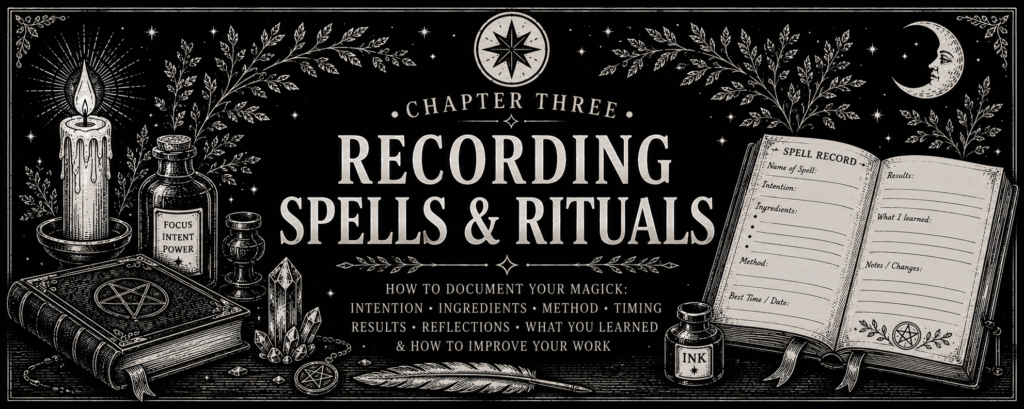
A Full Spell Record Template

SPELL NAME
Code:
Date:
Time:
Location:
INTENTION
PRACTICAL GOAL
SOURCE
Original / adapted / traditional / modern source.
INGREDIENTS
CORRESPONDENCE REASONS
TIMING
Moon / day / season / other.
PREPARATION
EMOTIONAL STATE BEFORE
METHOD
Numbered steps.
WORDS / INCANTATION
VISUALISATION
PRACTICAL ACTION
IMMEDIATE OBSERVATIONS
INTERPRETATION
REVIEW DATE
OUTCOME
ALTERNATIVE EXPLANATIONS
WHAT WORKED
WHAT I WOULD CHANGE
FINAL REFLECTION
This gives you an excellent repeatable structure.

A Full Ritual Record Template

RITUAL NAME

Date:
Purpose:
Tradition/source:
Participants:
Location:

HISTORICAL / SEASONAL CONTEXT

PREPARATION

ALTAR

OPENING

SACRED SPACE

OFFERINGS

MAIN RITUAL

SPELLWORK INCLUDED

DIVINATION

CLOSING

IMMEDIATE EXPERIENCE

OBSERVATIONS

INTERPRETATION

LATER REFLECTION

WHAT I WOULD CHANGE

SOURCES

Practical Exercise: Reconstruct an Old Spell

Choose one spell you performed previously.
Without checking old notes, write what you remember.
Then compare with any records you have.
Notice:
  • What you forgot
  • What you changed in memory
  • Which details seemed more important later
This demonstrates why written records matter.

Practical Exercise: Write a Clear Intention

Take:

“Money.”

Rewrite it three times.
Too vague
Money.
Better
Increase income.
Useful

“Support my efforts to gain two new paying customers during the next month.”

Then write the practical action.
This is the level of clarity to aim for.

Practical Exercise: Observation Versus Interpretation

Imagine:

Your candle goes out during a ritual.

Write two sections.
Observation
The flame went out after approximately seven minutes.
Possible physical explanations
  • Draught
  • Wick issue
  • Wax
  • Container
Magical interpretation
If any.
This exercise helps prevent instant magical conclusions.

Practical Exercise: Record a Failed Spell

Choose a past working that did not produce the result you hoped for.
Write:
Original intention
What I did
What happened
What did not happen
Practical actions I took
Possible reasons
What I learned
Do not turn the exercise into self-criticism.
The goal is learning.

Practical Exercise: Simplify a Spell

Take a ritual containing five or more ingredients.
For every item ask:

“What job is this doing?”

Remove anything duplicated or unnecessary.
Try reducing it to:
  • One intention
  • One main symbol
  • One action
Notice whether the ritual becomes clearer.

Practical Exercise: Create Your First Spell Index

Make a table:
CodeSpellIntentionDateOutcome
001    
002    
003    
After twenty workings, this becomes extremely useful.

Journal Prompts

  1. Why do I perform spells?
  2. What do I believe a spell actually does?
  3. Which magical methods feel natural to me?
  4. Which feel performative or forced?
  5. Do I prefer simple or elaborate rituals?
  6. How clearly do I usually define intentions?
  7. Do I take practical action alongside magic?
  8. Do I record unsuccessful workings?
  9. How do I decide whether something “worked”?
  10. Do I tend to reinterpret outcomes?
  11. How do I distinguish coincidence from causation?
  12. Does it matter to me whether I can prove a spell caused something?
  13. Which ingredients do I repeatedly use?
  14. Why?
  15. Which timing systems do I genuinely use?
  16. Do I need them?
  17. What ethical boundaries do I have?
  18. How do I treat other people’s privacy?
  19. Which ritual experiences have been meaningful even without external results?
  20. What would make my spell records more useful five years from now?
Finish with:
I record my magic as it happened, not as I wish I remembered it. I allow success, uncertainty and failure to teach me equally.

Common Spell-Recording Mistakes

Writing only the recipe

Record purpose and outcome too.

Forgetting the original intention

Write it before beginning.

Recording only successful spells

This creates a distorted record.

Rewriting the outcome

Preserve your original goal.

Ignoring practical action

Magic does not need to replace ordinary effort.

Treating every candle movement as a sign

Physical causes exist.

Treating every coincidence as proof

Record meaning without claiming certainty.

Copying spells without sources

Keep track of where ideas came from.

Using ingredients without understanding them

Know why each item is present.

Using unsafe materials

Magical symbolism does not override safety.

Overcomplicating every ritual

More ingredients do not automatically mean more power.

Sharing other people’s private information

Protect confidentiality.

Blaming yourself when a spell does not work

Reflection should not become self-punishment.

Never reviewing old entries

The greatest value often appears later.

Key Takeaways

  • A spell record should capture more than ingredients and instructions.
  • Record intention before beginning.
  • Distinguish the magical intention from the practical goal.
  • Record practical action alongside spellwork.
  • Date every working.
  • Record sources and adaptations.
  • Note why each ingredient was selected.
  • Timing is optional and should have a purpose.
  • Record emotional and environmental context when relevant.
  • Write methods clearly enough to repeat.
  • Separate observation from interpretation.
  • Avoid treating every candle, weather or animal event as automatic supernatural confirmation.
  • Record unsuccessful and ambiguous outcomes.
  • Confirmation bias can affect magical interpretation just as it affects other areas of human reasoning.
  • An event following a spell does not by itself prove the spell caused it.
  • Coincidence and personal meaning can coexist.
  • Review outcomes after an appropriate amount of time.
  • Repeated workings can be versioned and compared.
  • Privacy and consent matter.
  • Safety still applies to fire, herbs, oils and other ritual materials.
  • The purpose of recording magic is not to prove that you are powerful.
  • It is to understand how you practise.

Closing Thoughts

A Book of Shadows can contain hundreds of spells.
But the number is not what makes it valuable.
Imagine two books.
The first contains three hundred spells copied from websites.
Each page is beautifully decorated.
No dates.
No results.
No sources.
No explanation of why anything was used.
The second contains twenty spells.
Each one records:
  • What the practitioner intended
  • Why they chose the ingredients
  • What they actually did
  • How they felt
  • What happened afterwards
  • What did not happen
  • What they learned
Which book tells you more about that witch’s practice?
Almost certainly the second.
Because a spell record is not simply a recipe.
It is evidence of a relationship between:
intention, symbolism, action, experience and reflection.
Some workings will feel extraordinary.
Some will feel ordinary.
Some will appear successful.
Some will not.
Some will produce outcomes you cannot easily interpret.
Record all of them.
Do not polish the past until every spell appears successful.
Do not turn uncertainty into failure.
Do not turn every coincidence into proof.
And do not become afraid of mystery simply because you are practising discernment.
You are allowed to write:

“I don’t know what happened here.”

That may be one of the most useful sentences in your entire Book of Shadows.
Because genuine practice is not built by convincing yourself that every ritual works perfectly.
It is built through:
curiosity, repetition, honesty and attention.
Over time, patterns may emerge.
You may discover that candle work suits you.
Perhaps written petitions are particularly meaningful.
Perhaps you love seasonal ritual but find highly ceremonial magic uncomfortable.
Perhaps a simple three-minute grounding practice consistently changes the quality of your spellwork.
Those discoveries cannot be copied from another witch’s grimoire.
They come from your own record.
And that is exactly what your Book of Shadows is for.
Record the intention. Record the method. Record what happened. Record what didn’t. Then let experience—not expectation—teach you what comes next.
Scroll to Top
