⬅Foundation home
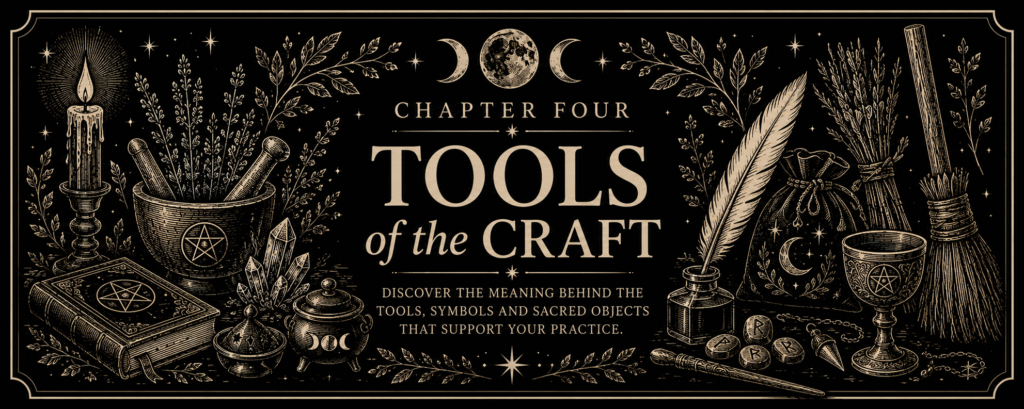

“A tool does not create the magic. It helps the practitioner focus, symbolise, remember and act with intention.”
Introduction
Images of witchcraft are often filled with familiar objects: candles burning beside an old book, a wand resting across an altar, herbs hanging from the ceiling, a cauldron simmering over a flame and a collection of crystals glinting in the moonlight.
These objects have become so strongly associated with witchcraft that beginners can easily assume they are essential.
They are not.
You do not need an elaborate altar, a cupboard full of herbs or a collection of expensive ritual tools to practise witchcraft. Many forms of folk magic have always used ordinary household objects, locally available plants and simple acts of intention. A cup, a candle, a bowl of water or even your own hands may be all that a particular practice requires.
Magical tools are not sources of power by themselves.
They are ways of directing attention, expressing symbolism and creating a sense of purpose. They can help mark the difference between ordinary time and ritual time. They can give physical form to an intention that might otherwise feel abstract.
A tool may also become personally meaningful through repeated use. A candleholder used during years of meditation, a spoon used to stir herbal blends or a notebook filled with rituals can develop a strong emotional and symbolic importance.
This chapter explores the tools most commonly associated with modern witchcraft, folk magic, Wicca, ceremonial traditions and solitary practice.
Not every tool belongs to every tradition, and not every practitioner uses them in the same way.
As you read, consider which objects genuinely support your practice rather than which ones you feel you are expected to own.
What Makes an Object a Magical Tool?
Almost any object can become a magical tool when it is used with clear purpose.
A magical tool may help you:
Focus your attention
Represent an element, deity, spirit or intention
Create boundaries around a ritual
Hold or carry symbolic meaning
Perform a practical action
Record your experiences
Support meditation or divination
Connect with a particular tradition
Mark an object as sacred or personally significant
The same object may serve very different purposes for different practitioners.
A bowl may hold water on one altar, herbs on another and written intentions on a third. A knife may be used symbolically to direct energy in one tradition, while another practitioner may use a small blade only for cutting herbs or cords.
Meaning comes from context, tradition and personal relationship.
Do You Need to Consecrate Your Tools?
Consecration is the act of dedicating an object to a sacred, spiritual or magical purpose.
Some traditions include formal consecration rituals. Others use a simple blessing, cleansing or statement of intention. Some practitioners do not consecrate tools at all.
A basic dedication might involve holding the object and saying:
“I dedicate this tool to my practice. May it be used with wisdom, clarity and care.”
You might also cleanse the object before using it for the first time.
Common cleansing methods include:
Wiping it physically clean
Passing it through incense smoke
Placing it beside a bowl of salt
Sound cleansing with a bell or chime
Leaving it in moonlight
Visualising unwanted energy leaving it
Sprinkling it lightly with water, where safe for the material
Not every cleansing method is suitable for every object.
Water can damage paper, wood, metals and some crystals. Salt can corrode certain surfaces. Smoke may be unsuitable for people with asthma, pets, rented accommodation or limited ventilation.
A practical clean may be all that is needed.
The Altar
An altar is a dedicated space used for reflection, ritual, prayer, offerings, meditation or magical work.
It may be large and elaborate, or it may consist of a single candle on a windowsill.
An altar can be:
Permanent
Temporary
Seasonal
Devotional
Ancestral
Elemental
Practical
Decorative
Hidden or discreet
Some people maintain different altars for different purposes. Others use one flexible space that changes throughout the year.
A simple altar might include:
A candle
A small bowl of water
A natural object
A meaningful image or symbol
A notebook
A seasonal item
A cloth
An altar does not need to face a particular direction unless your tradition specifies one.
It should be placed somewhere safe, especially if candles, incense, oils or loose herbs are being used.
The Altar Cloth
An altar cloth protects the surface beneath your tools and helps define the ritual area.
It may also carry symbolic meaning through its colour, pattern or material.
For example:
Black may be associated with protection, mystery or banishing
White may represent clarity, purification or peace
Green may represent nature, growth or prosperity
Red may symbolise courage, vitality or passion
Blue may represent healing, calm or intuition
Purple may be linked with spiritual insight or divination
These associations are not universal rules. Colour meanings vary across cultures and personal traditions.
A cloth can be bought, handmade, embroidered, printed or adapted from fabric you already own.
Fire safety is essential. Keep loose cloth away from flames, hot wax and charcoal burners.
Candles
Candles are among the most commonly used tools in modern witchcraft.
They can represent:
Fire
Transformation
Illumination
Hope
Focus
Spiritual presence
The passage of time
Candles may be used in meditation, spellwork, seasonal rituals, remembrance practices and devotional work.
Some practitioners choose candle colours according to traditional correspondences. Others use whatever is available.
A white candle is often treated as a flexible all-purpose option.
Candles do not need to be large or expensive. Small spell candles, tealights and birthday candles can all be used effectively.
Candle Safety
Never leave a burning candle unattended.
Place candles on stable, heat-resistant surfaces and keep them away from:
Curtains
Paper
Loose clothing
Dried herbs
Pets
Children
Flammable altar cloths
Do not dress a candle so heavily with herbs or oil that the flame becomes unstable. Dried botanicals can ignite quickly.
Extinguish the candle if the flame becomes unusually high, smoky or erratic.
The Wand
The wand is used in many magical and ceremonial traditions as a tool of direction, invocation and focus.
It may be used to:
Direct energy
Draw symbolic boundaries
Point toward an object or direction
Bless tools
Trace symbols
Open or close ritual space
Wands are often made from wood, although they can also be made from metal, crystal or other materials.
Different woods have acquired different symbolic associations over time. Oak may be linked with strength, willow with intuition and rowan with protection. These meanings vary by region and tradition.
A wand does not need to come from a particular tree.
You may:
Buy one
Carve one
Use a fallen branch
Decorate a simple dowel
Use your finger instead
When gathering wood, avoid damaging living trees and follow local laws.
Never remove branches from private land, protected woodland or sacred sites without permission.
The Athame
An athame is a ritual knife most commonly associated with Wicca and some ceremonial forms of modern witchcraft.
It is generally used symbolically rather than for physical cutting.
An athame may be used to:
Direct energy
Trace a ritual circle
Mark symbolic boundaries
Invoke the elements
Point during ritual work
It is often described as a double-edged knife with a dark handle, although this appearance is not universal.
The athame should not be confused with every ritual knife found in magical traditions. Its exact role and symbolism vary between lineages.
Some practitioners associate the athame with fire, while others associate it with air.
Because it is a blade, it must be stored responsibly and kept away from children.
A symbolic alternative may be used where owning or carrying a knife would be unsafe or illegal.
The Boline
In some Wiccan and magical traditions, the boline is a practical working knife.
Unlike the athame, the boline may be used for physical tasks such as:
Cutting herbs
Carving candles
Trimming cords
Preparing ritual materials
Cutting branches where lawful and ethical
It is often depicted with a curved, pale or white handle, but this is a traditional convention rather than a requirement.
Many practitioners simply use ordinary scissors or a small craft knife instead.
The Chalice
The chalice is a ritual cup.
It may represent:
Water
Receptivity
Emotion
Intuition
The womb
Spiritual nourishment
It may hold water, wine, juice, herbal tea or another ritual drink.
In some traditions, the chalice carries specific religious symbolism. In others, it is simply a vessel used for offerings or shared ritual drinks.
Any clean cup can serve this purpose.
Do not consume liquids that have been mixed with unsafe herbs, essential oils, crystals, incense ash or ritual substances.
Essential oils should not be added to drinks unless used in a properly formulated food product under expert guidance.
The Pentacle
A pentacle is usually a five-pointed star enclosed within a circle, though the word can also refer more broadly to a ritual disc bearing a pentagram or other magical symbol.
In many modern witchcraft traditions, the pentacle represents:
Earth
Protection
Balance
The five elements
The human relationship with nature
The material world
The five points are often associated with earth, air, fire, water and spirit.
The circle may represent unity, wholeness or protection.
A pentacle may appear on an altar tile, pendant, book cover or ritual object.
It is important to distinguish between a pentagram and a pentacle.
A pentagram is a five-pointed star. A pentacle is commonly understood in modern witchcraft as a pentagram enclosed within a circle, especially when used as a magical or ritual symbol.
The symbol has existed in many cultures and historical contexts and has not always carried the same meaning.
The Cauldron
The cauldron is one of the most recognisable symbols of witchcraft.
Historically, cauldrons were ordinary household vessels used for cooking, heating water and preparing food.
In magical symbolism, the cauldron may represent:
Transformation
Rebirth
Creation
The womb
The element of water
The mysteries of life and death
Modern practitioners may use cauldrons for:
Holding water
Mixing dry herbs
Burning written intentions
Containing ritual objects
Symbolic transformation work
Seasonal decoration
A cauldron used for burning must be made from a heat-safe material such as cast iron and placed on a fire-resistant surface.
Do not assume a decorative cauldron is safe for flames.
Never burn charcoal, resin or large quantities of herbs in an enclosed room without proper ventilation.
The Besom or Ritual Broom
The besom is a broom associated with household protection, cleansing and ritual space.
It may be used symbolically to sweep away stagnant energy before a ritual.
The bristles often do not touch the floor. Instead, the practitioner makes sweeping motions just above the surface.
A besom may also be placed:
Near a doorway
Above an entrance
Beside an altar
In a ritual circle
As part of a seasonal display
The popular image of witches flying on broomsticks comes from a complex mixture of folklore, satire, fear and later popular culture.
Modern ritual use is usually symbolic and connected to cleansing, boundaries and domestic protection.
The Bell
Bells have long been used in religious, folk and ceremonial traditions.
Their sound may be used to:
Mark the beginning of a ritual
Clear a space
Call attention
Signal a transition
Invite spiritual presence
End a meditation
Sound changes the atmosphere of a room immediately, which makes the bell especially useful for creating ritual focus.
Chimes, singing bowls, clapping and recorded sounds may be used instead.
Be considerate of neighbours, household members and animals that may be sensitive to loud noise.
The Mortar and Pestle
The mortar and pestle is both a practical and symbolic tool.
It may be used to crush and blend:
Dried herbs
Resins
Spices
Incense ingredients
Salt mixtures
The physical act of grinding ingredients can become part of the ritual. The practitioner may focus on an intention while combining the materials.
Use separate equipment for non-food-safe materials.
A mortar used for toxic botanicals, incense, resins or ritual mixtures should not later be used for cooking.
Some herbs and resins can irritate the skin or lungs when crushed, so work in a ventilated area and avoid breathing in fine powders.
Incense and Smoke
Incense is used in many spiritual and magical traditions around the world.
It may be used for:
Creating atmosphere
Marking sacred time
Meditation
Cleansing
Offerings
Devotion
Elemental symbolism
Common forms include:
Sticks
Cones
Loose blends
Resins
Dried herbs
Woods
Different cultures have developed their own incense traditions, and these should not all be treated as interchangeable.
When working with smoke, consider:
Ventilation
Asthma and respiratory conditions
Pets
Fire alarms
Neighbours
Children
The safety of the plant being burned
Many essential oils, incense ingredients and smoke products can be harmful to animals, especially in poorly ventilated rooms.
Smoke-free alternatives include:
Bells
Sprays made with skin-safe or room-safe formulations
Visualisation
Salt
Water
Light
Sound
Physical cleaning
Physical cleaning is often the most effective first step in refreshing a space.
Herbs
Herbs are used in many forms of folk magic, household tradition and modern witchcraft.
They may be included in:
Sachets
Spell jars
Baths
Incense
Oils
Teas
Floor washes
Offerings
Candle work
Amulets
Seasonal decorations
Herbs may be chosen for their traditional associations, scent, appearance, local significance or personal meaning.
For example, rosemary is often associated with remembrance and protection, while lavender may be associated with peace, sleep and purification.
These correspondences are not universal scientific facts. They come from folklore, traditional use, symbolism and later magical systems.
Herbal Safety
Natural does not mean harmless.
Before using any herb internally or on the skin, check:
Correct identification
Toxicity
Allergies
Medication interactions
Pregnancy and breastfeeding safety
Dosage
Preparation method
Suitability for children
Suitability around pets
Some herbs commonly used in magical practice are unsafe to ingest.
Do not drink ritual blends unless every ingredient has been confirmed as food-safe and suitable for you.
Oils and Anointing Blends
Oils may be used to anoint candles, tools, doorways or ritual objects.
Some practitioners create blends based on a particular intention, such as protection, confidence or divination.
A ritual oil may contain:
A carrier oil
Dried botanicals
Essential oils
Symbolic ingredients
Essential oils are highly concentrated and should not be used neat on the skin.
They must be properly diluted in a suitable carrier oil.
Some essential oils are phototoxic, irritating, sensitising or unsuitable during pregnancy. Others are unsafe around pets.
A spiritual or ritual oil should not automatically be treated as a cosmetic product.
Something that is safe for an object may not be safe for human skin.
Never use ritual oils in the eyes, on broken skin or internally.
Crystals and Stones
Crystals are popular in modern witchcraft, although not every tradition uses them.
They may be used for:
Meditation
Symbolism
Altar decoration
Divination
Spellwork
Carrying as talismans
Different stones are commonly assigned correspondences.
Amethyst may be linked with spiritual awareness, rose quartz with love and black tourmaline with protection.
These are symbolic and traditional associations rather than scientifically proven properties.
Crystals should not replace medical treatment or professional support.
Crystal Safety
Some crystals are toxic, fragile or reactive.
Avoid making crystal-infused drinking water unless you have reliable mineralogical knowledge. Even stones commonly considered safe may have been treated with dyes, coatings or chemicals.
Some crystals may be damaged by water, sunlight or salt.
Research each stone individually before cleansing or using it.
The Book of Shadows
A Book of Shadows is a personal or traditional record of magical practice.
The term became strongly associated with Wicca, where it may refer to a body of ritual material passed through a tradition. In broader modern usage, many solitary practitioners use the term for their own magical journal.
A Book of Shadows may contain:
Rituals
Spells
Correspondences
Dreams
Divination readings
Herbal notes
Moon observations
Seasonal practices
Reflections
Research
Results of magical work
It does not need to be beautifully decorated.
Its purpose is to support learning and record experience.
A digital document, notebook, binder or collection of loose pages can all serve the same function.
Some practitioners distinguish between a Book of Shadows, which contains practical magical material, and a grimoire, which may be a more formal collection of spells or magical instructions. In modern usage, the terms often overlap.
The Grimoire
A grimoire is a book of magical knowledge, instructions or rituals.
Historically, grimoires were often connected with ceremonial magic, astrology, spirit work, talismanic practice and religious symbolism.
Modern personal grimoires may include:
Spells
Ritual methods
Symbolic systems
Correspondence charts
Recipes
Prayers
Sigils
Divination methods
Magical alphabets
Spirit or deity research
Not every old magical book is safe or appropriate to copy without context.
Historical texts may contain outdated beliefs, dangerous substances, religious assumptions or instructions that require specialist knowledge.
Study critically rather than treating age as proof of truth.
Divination Tools
Divination is the practice of seeking insight, reflection or guidance through symbolic methods.
Common tools include:
Tarot cards
Oracle cards
Runes
Pendulums
Scrying mirrors
Crystal balls
Tea leaves
Dice
Coins
Bibliomancy
Casting bones or charms
Divination does not have to be viewed as a fixed prediction of the future.
Many practitioners use it as a way to:
Explore possibilities
Reflect on emotions
Identify patterns
Consider different choices
Develop intuition
Prompt journalling
Divination should not replace medical, legal, financial or professional advice.
It is also wise to avoid using it repeatedly to ask the same question, especially when anxiety is involved.
Tarot and Oracle Cards
Tarot decks usually contain seventy-eight cards divided into the Major Arcana and Minor Arcana.
Oracle decks do not follow one standard structure. The number of cards, themes and meanings are decided by the creator.
Cards may be used for:
Reflection
Storytelling
Decision-making
Meditation
Creative inspiration
Spiritual guidance
A reader does not need to memorise every meaning before beginning.
Observation, symbolism and context are as important as traditional interpretations.
Ethical readers avoid making frightening claims, diagnosing illness or presenting a reading as unavoidable fate.
The Pendulum
A pendulum is a weighted object suspended from a chain or cord.
It may be used for yes-or-no questions, dowsing or reflective practice.
Small movements may be influenced by the ideomotor effect, in which unconscious muscular movements cause the pendulum to move.
Some practitioners interpret the movement spiritually. Others use it as a way of accessing intuition or unconscious preference.
Before using a pendulum, decide what each direction will mean.
Avoid relying on it for serious decisions involving health, money, safety or relationships.
Runes
Runes are letters from historical Germanic writing systems.
The best-known rune row used in modern divination is the Elder Futhark, which contains twenty-four characters.
Modern rune divination often assigns symbolic meanings to each character.
However, not every modern interpretation is directly preserved from ancient historical practice.
Runes are a genuine historical writing system, while many current divinatory meanings have been shaped by modern occultism, scholarship, reconstruction and personal practice.
It is respectful to learn about their linguistic and cultural history rather than viewing them only as mystical symbols.
Scrying Tools
Scrying involves gazing into a surface or medium to encourage visions, images, symbols or intuitive impressions.
Scrying tools may include:
A dark mirror
A bowl of water
A crystal sphere
A candle flame
Smoke
Clouds
Scrying often works best in a quiet, dimly lit environment.
The practitioner softens their gaze rather than staring intensely.
Images may be understood spiritually, symbolically or psychologically.
Sessions should be kept relatively short, especially for beginners. Eye strain, fatigue and imagination can all affect what is perceived.
The Mirror
Mirrors may be used in protection work, self-reflection, glamour magic or scrying.
A black scrying mirror is usually a dark reflective surface designed to reduce ordinary reflections and encourage a softened visual focus.
Mirrors have also appeared in folklore as symbols of:
Truth
The soul
Vanity
Protection
Doorways
Reversal
Hidden knowledge
Folklore does not represent one universal belief system. Mirror traditions differ widely between cultures and periods.
Bowls and Dishes
Simple bowls are among the most versatile magical tools.
They can hold:
Water
Salt
Herbs
Offerings
Stones
Written intentions
Ritual ingredients
Different bowls should be used for food-safe and non-food-safe materials.
Do not reuse a container for eating after it has held essential oils, incense ash, toxic plants or unknown ritual ingredients.
Salt
Salt has a long history of practical, religious and symbolic use.
In modern witchcraft, it is often associated with:
Cleansing
Purification
Preservation
Protection
Boundaries
The element of earth
Salt may be placed in a bowl, included in a ritual mixture or used symbolically to mark boundaries.
Avoid scattering salt outdoors.
Large amounts can damage soil, plants and freshwater environments.
Do not leave bowls of salt where pets may consume them.
Water
Water may represent:
Emotion
Intuition
Cleansing
Healing
Flow
Adaptability
Practitioners may work with rainwater, river water, seawater, spring water or ordinary tap water.
Water collected outdoors may contain bacteria, pollutants or parasites.
It should not automatically be considered safe to drink or apply to the skin.
Seawater should not be poured onto soil or houseplants because of its salt content.
The symbolic value of water does not depend on it being collected from a special location.
The Offering Bowl
Offerings may be given to ancestors, deities, spirits, the land or as an expression of gratitude.
Common offerings include:
Water
Flowers
Food
Herbs
Incense
Art
Song
Prayer
Acts of service
Offerings should be chosen respectfully.
Do not leave food, salt, wax, plastic, coins, crystals or non-native plants in natural places.
They may harm wildlife or damage the environment.
An offering can be removed and disposed of responsibly after the ritual. It does not need to remain permanently outdoors.
Statues, Images and Sacred Symbols
Images may help a practitioner focus on a deity, ancestor, spirit, archetype or spiritual principle.
These may include:
Statues
Printed images
Handmade art
Photographs
Symbols
Natural objects
An image is not necessarily worshipped as a physical object. It may act as a representation or focal point.
When working with religious or cultural imagery, research its meaning and context.
Some sacred symbols belong to living traditions and should not be removed from their cultural background simply because they look magical.
Amulets, Talismans and Charms
These terms are sometimes used interchangeably, but they may have different meanings.
An amulet is often understood as an object carried or worn for protection.
A talisman is often created or charged to attract a particular influence, such as confidence, luck or success.
A charm may refer to an object, spoken formula or small magical act.
Examples include:
Jewellery
Written symbols
Knotted cords
Herb sachets
Coins
Carved stones
Small bottles
Protective symbols
The distinction varies between traditions, so there is no single universal definition.
Cord and Thread
Cord is used in:
Knot magic
Binding
Releasing
Handfasting
Protection
Intention work
Symbolic connection
A practitioner may tie knots while focusing on an intention or untie them as part of a release ritual.
Cord-cutting rituals symbolise ending an attachment, pattern or emotional connection.
They should not be interpreted as a substitute for communication, boundaries, counselling or practical action.
Never tie cords around a person or animal in a way that restricts movement or circulation.
The Needle and Scissors
Needles, pins and scissors appear in many forms of household magic and folk practice.
They may symbolise:
Separation
Protection
Repair
Precision
Binding
Severing
Craftsmanship
They may also be used practically in poppets, sachets, cloth charms and stitched talismans.
Store sharp objects safely and avoid leaving pins loose in herbs, candles or ritual materials.
Poppets and Effigies
A poppet is a small figure used to represent a person, intention or situation.
Poppets have appeared in different forms across European folk magic and other cultures.
They may be used for:
Healing symbolism
Protection
Blessing
Habit change
Emotional release
Representation
Popular culture often presents effigy magic only as harmful, but representational figures have also been used for beneficial and protective purposes.
Consent and ethics matter, especially when a working is intended to influence another person.
The Witch’s Ladder
A witch’s ladder is a cord, rope or braided object containing knots, feathers, beads or charms.
Modern forms may be used for:
Protection
Prayer
Counting repetitions
Intention-setting
Meditation
Memory
Some historical objects later described as witch’s ladders have uncertain interpretations, so care should be taken when making firm claims about their original purpose.
Modern practitioners have developed their own meaningful uses for the form.
Feathers, Bones and Natural Objects
Natural objects may be collected for symbolism, study or altar use.
These can include:
Feathers
Shells
Stones
Seed pods
Fallen branches
Antlers
Bones
Leaves
Before collecting, consider:
Wildlife protection laws
Landowner permission
Hygiene
Ethical sourcing
Cultural significance
Whether the object is safe to handle
In the United Kingdom, possession and sale of certain bird feathers, eggs and wildlife remains may be restricted.
Finding an object does not always mean it is legal to keep.
Do not remove items from protected sites, graveyards, archaeological locations or private land without permission.
The Staff
A staff may be used as:
A walking aid
A symbol of authority
A ritual tool
A connection to the land
A way of directing attention or energy
Staffs appear in many spiritual, ceremonial and folkloric traditions.
A magical staff may be decorated with carvings, cord, stones or symbols, although it can remain completely plain.
Like the wand, it is optional.
Clothing, Robes and Jewellery
Some practitioners wear special clothing during ritual.
This may help create a shift in mindset and separate ritual activity from everyday life.
Others prefer ordinary clothing or practise without any special garments.
Jewellery may act as:
An amulet
A devotional symbol
A reminder of intention
A marker of identity
A protective object
There is no requirement to dress in a particular way to practise witchcraft.
Appearance is not proof of knowledge, skill or authenticity.
Everyday Objects as Magical Tools
Many effective magical practices use objects already found in the home.
Examples include:
A wooden spoon for stirring intention into food
A mug used only for ritual tea
A jar for written wishes
A key representing opportunity
A mirror for self-reflection
A bowl of water for cleansing
Thread for knot magic
A notebook for dreams
A pebble carried as a grounding object
A houseplant used as a reminder of growth
A tool does not become less meaningful because it is ordinary.
For many practitioners, the most powerful objects are those that have been used repeatedly and intentionally over time.
Choosing Your First Tools
Beginners are often encouraged to buy too much too quickly.
Before purchasing an item, ask:
What will I use this for?
Does it belong to the kind of practice I am exploring?
Could I use something I already own?
Is it safe and legally sourced?
Am I buying it because it is useful or because I feel pressured?
Do I understand the symbolism behind it?
Can I store and care for it properly?
A useful beginner collection might include:
A notebook
A candle
A heat-safe holder
A bowl
A deck of cards, if interested in divination
A small selection of well-researched herbs
One personally meaningful object
That is more than enough to begin.
Caring for Your Tools
Tools should be cared for practically as well as spiritually.
This may include:
Cleaning them
Drying them properly
Keeping blades sharp and safely stored
Checking candles and holders for damage
Keeping herbs labelled and dated
Discarding mouldy ingredients
Storing oils away from heat and sunlight
Keeping toxic substances away from food
Checking cords and chains for wear
Protecting cards and books from damp
Not every change in an object is a spiritual sign.
Rust, mould, discolouration and cracking usually have practical causes and should be handled accordingly.
Ethical Sourcing
Modern witchcraft has created a large market for crystals, herbs, feathers, shells, resins and sacred woods.
Not all of these are sourced responsibly.
Before buying, consider:
Environmental impact
Labour conditions
Overharvesting
Wildlife protection
Cultural significance
Whether the item is endangered or restricted
Whether a local alternative exists
An item is not spiritually superior because it is rare or imported.
Local, ordinary and sustainably sourced materials may be more meaningful than exotic objects with uncertain origins.
Closed and Initiatory Traditions
Some magical and spiritual tools belong to closed, initiatory or culturally specific traditions.
A closed practice is one that is not open to everyone simply through personal interest. Participation may depend on ancestry, community membership, formal initiation or guidance from authorised teachers.
It is important to distinguish respectful learning from taking sacred objects, ceremonies or symbols out of context.
Before using an unfamiliar tool, ask:
Where does it come from?
Is it part of a living tradition?
Is it intended for public use?
Has the community asked outsiders not to use it?
Am I learning from reliable cultural sources?
Respect does not prevent learning. It encourages responsible learning.
The Most Important Tool
The most important magical tool is not the wand, candle, cauldron or crystal.
It is the practitioner.
Your attention, judgement, knowledge, imagination and willingness to act are central to your practice.
Tools can help you focus, but they cannot replace:
Study
Self-awareness
Ethical thinking
Patience
Practical action
Personal responsibility
A candle may represent courage, but you must still take the courageous step.
A prosperity charm may support your focus, but it cannot replace budgeting, planning or work.
A cleansing ritual may help you feel renewed, but it should accompany physical cleaning, communication and healthy boundaries where needed.
Magic and practical action are often strongest when they work together.
Building a Personal Relationship With Your Tools
A tool becomes meaningful through use.
You do not need to force an immediate connection.
Begin by learning:
What the tool has traditionally represented
How it is used in different paths
Whether it feels useful to you
How it affects your concentration
What experiences you associate with it
You may discover that some tools become central to your practice while others remain unused.
That is completely normal.
Your practice does not need to resemble anyone else’s altar, social media page or collection.
A carefully chosen set of meaningful tools is often more useful than a room full of objects that have no personal significance.
A Simple Tool-Dedication Ritual
This ritual can be adapted for any safe object.
You will need:
The tool
A clean cloth
A candle, if desired
Your journal
Begin by cleaning the object physically.
Sit quietly and hold it in your hands.
Consider:
Why you chose it
What you intend to use it for
What values you want it to represent
How you will care for it
You may then say:
“I dedicate this tool to thoughtful and responsible practice. May it help me focus clearly, act wisely and remember the intentions I place within my work.”
Place it on your altar or in its storage place.
Write down the date and your intention in your journal.
No elaborate ceremony is required.
The act of dedication is meaningful because you understand why you are doing it.
Key Takeaways
Magical tools support practice, but they are not essential.
The meaning of a tool depends on tradition, context and personal use.
Not every witch uses the same tools.
Ordinary household objects can be used magically.
Wiccan tools should not automatically be presented as universal to all witchcraft.
Safety is essential when using fire, herbs, blades, incense, oils and crystals.
Ethical and legal sourcing matters.
Tools should support practical action rather than replace it.
A small collection of meaningful objects is enough.
The practitioner remains the most important part of the practice.
Reflection
Before continuing, consider the following questions:
Which tools are you naturally drawn to?
Which tools do you already own that could become part of your practice?
Are there any objects you previously believed were essential?
Which tools genuinely support your focus?
How could you make your practice more sustainable?
Are there any objects you should research more carefully before using?
What does the word “sacred” mean to you?
How might an ordinary object become meaningful through repeated use?
You may wish to create a page in your Book of Shadows titled:
My Tools of the Craft
For each tool, record:
Its name
Its purpose
Its symbolic meaning
Where it came from
How you use it
Any safety notes
Any personal experiences connected with it
Your list may change as your practice develops.
That evolution is part of learning.
Closing Thoughts
Magical tools can be beautiful, practical and deeply meaningful.
They may help create atmosphere, preserve tradition, focus intention and transform an ordinary moment into a ritual one.
But tools should never become a measure of legitimacy.
A witch with a handmade altar and shelves of magical objects is no more authentic than someone who practises quietly with a candle and notebook.
Choose tools because they serve your practice.
Learn their history.
Use them safely.
Source them responsibly.
Allow them to gather meaning through experience.
The power of a tool does not come from its price, appearance or rarity.
It comes from the relationship you build with it.