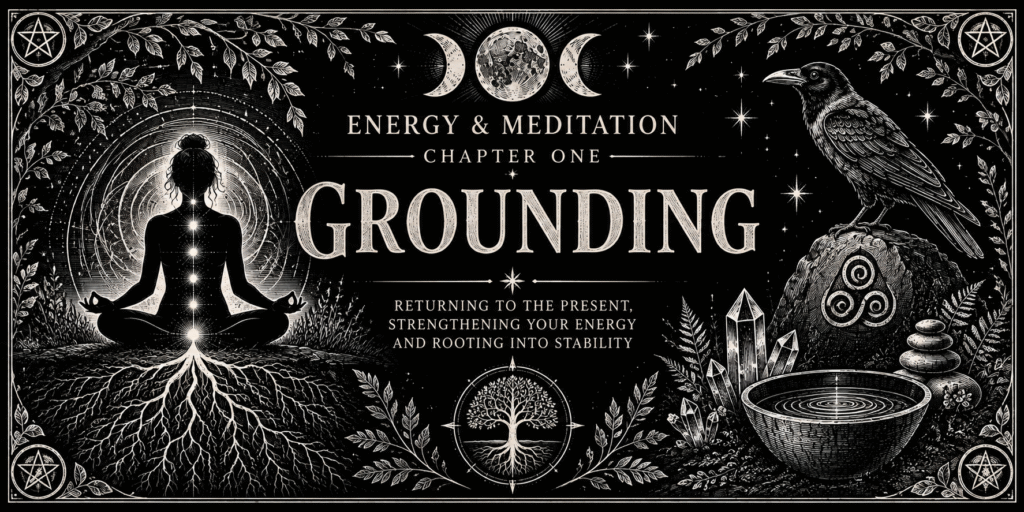

“Before you reach outward, learn how to return inward. Before you raise energy, learn how to stand steadily within yourself.”
Introduction
Grounding is one of the most frequently recommended practices in modern witchcraft, meditation and spiritual work.
It is also one of the most misunderstood.
You may have heard instructions such as:
“Send roots into the earth.”
“Release excess energy.”
“Reconnect with your body.”
“Eat something after ritual.”
“Stand barefoot on the ground.”
“Come back into the present moment.”
These practices are often grouped under the same word, yet they do not all mean exactly the same thing.
Within witchcraft, grounding is commonly described as the process of becoming stable, present and connected before or after magical work. Some practitioners understand this as balancing or releasing spiritual energy. Others use grounding as a symbolic visualisation that helps them settle their attention. In psychological and wellbeing settings, grounding usually refers to techniques that redirect attention towards the present environment, the body and immediate sensory experience.
These interpretations may overlap, but they should not be confused.
This chapter will help you understand grounding as:
A practical present-moment skill
A preparation for ritual and meditation
A method of settling after emotionally intense work
A symbolic or spiritual practice
A way of noticing your body and surroundings
A personal routine that can be adapted safely
You will not be asked to believe that one invisible mechanism has been scientifically proved.
Instead, you will learn several ways of understanding grounding, explore different techniques and discover which methods genuinely help you feel more stable, aware and present.
What Does Grounding Mean?
At its simplest, grounding means:
Returning your attention to the present moment and re-establishing a sense of physical, emotional or spiritual steadiness.
The word is used differently in different settings.
Psychological grounding
In mental-health and wellbeing contexts, grounding techniques are used to redirect attention away from overwhelming thoughts, intrusive memories or distress and towards the current environment. This may involve naming things you can see, feeling your feet against the floor, describing the room or focusing upon sensory information. NHS and trauma-support resources describe grounding as a way of reconnecting with the present moment rather than remaining absorbed in distressing thoughts or memories.
Meditative grounding
In meditation, grounding may mean becoming aware of:
Your breathing
The weight of your body
The support beneath you
Sounds in the room
Physical sensations
Your immediate surroundings
This is closely related to mindfulness: deliberately noticing internal experience and the world around you without becoming completely carried away by every thought.
Magical grounding
Within modern witchcraft, grounding is often understood as stabilising yourself before magical work or returning to ordinary awareness afterwards.
A practitioner may imagine:
Roots growing from the body into the earth
Excess energy flowing downwards
Strength rising from the land
The body becoming heavy and steady
A protective connection forming between self and place
This is a spiritual or symbolic model rather than an established scientific explanation.
Some witches regard the experience as literal energy exchange. Others treat the imagery as a method of focusing attention and changing their emotional state. Both may perform the same exercise while interpreting it differently.
Physical grounding
Sometimes the most useful grounding is entirely practical:
Drinking water
Eating a nourishing snack
Washing your hands
Stretching
Changing position
Opening a window
Walking around the room
Tidying ritual materials
Speaking to another person
Resting
These actions reconnect the practitioner with ordinary bodily needs and the immediate environment.
What Grounding Is Not
Grounding is useful, but it is not a magical cure for every difficult feeling.
It does not guarantee that you will:
Immediately become calm
Stop every intrusive thought
Remove all anxiety
Eliminate trauma responses
Feel spiritually connected
Sense energy
Achieve perfect emotional control
Become immune to overwhelm
A grounding exercise may help you become more oriented and present without making you feel completely relaxed.
That distinction matters.
Sometimes grounding means:
“I can notice where I am and what is happening.”
It does not always mean:
“I now feel peaceful.”
You may remain upset while also becoming more connected to your body, surroundings and choices.
That can still be a successful grounding experience.
Grounding Is Not the Same as Relaxation
Grounding and relaxation can overlap, but they are not identical.
Relaxation aims to reduce tension or arousal.
Grounding aims to increase present-moment orientation and stability.
A person may feel:
Present but not relaxed
Relaxed but distracted
Calm but disconnected
Physically tense but mentally clear
For example, firmly pressing your feet into the floor may help you feel more present even if your heart is still beating quickly.
Likewise, lying down with gentle music may feel relaxing but could make a tired or dissociated person feel less alert.
Choose the method according to what you need.
Ask:
Do I need to soften and rest, or do I need to become more alert and connected?
Grounding, Centring and Shielding
These terms are often used interchangeably online, but it is useful to separate them.
Grounding
Grounding reconnects you with the present, your body and your surroundings.
Its movement is often imagined as downward, outward or into the physical world.
Centring
Centring gathers your attention towards your inner point of balance.
Its movement is often imagined as inward.
Shielding
Shielding is a magical or psychological boundary practice in which a person imagines protection around themselves.
Its movement is often imagined as surrounding or enclosing.
A simple sequence might be:
Ground — recognise where you are.
Centre — gather your attention.
Shield — establish your chosen boundary.
Begin the work.
You do not have to use all three every time.
Why Ground Before Magical Practice?
Grounding can be useful before ritual, spellwork, divination or meditation because these activities require attention.
Before beginning, you may be carrying:
Stress from the day
Excitement
Anger
Worry
Distraction
Tiredness
Expectations about what “should” happen
Pressure to perform the ritual perfectly
A short grounding practice helps create a deliberate transition from ordinary activity into focused practice.
It can give you time to ask:
What am I feeling?
Am I able to concentrate?
Is this the right time to continue?
Is my intention still clear?
Do I feel physically safe and comfortable?
Am I acting from thoughtful choice or immediate emotion?
Grounding does not make your feelings disappear.
It helps you notice what you are bringing into the work.
Why Ground Afterwards?
Some people feel unsettled after intense ritual, meditation, divination or emotional reflection.
They may describe feeling:
Light-headed
Tired
Overstimulated
Detached
Emotional
Restless
Mentally “far away”
Absorbed in symbolism
Unable to return to ordinary tasks
Not every unusual sensation is evidence of magical energy.
Possible explanations may include:
Sitting still for a long time
Breathing differently
Fatigue
Hunger
Dehydration
Emotional activation
Strong expectations
The atmosphere of the ritual
Extended concentration
Standing up too quickly
Grounding afterwards can mark the clear end of the practice.
This might include:
Closing the ritual aloud
Extinguishing candles safely
Putting tools away
Stretching
Eating
Drinking
Washing
Opening curtains
Naming the date and time
Returning to a practical task
A good closing helps reinforce the boundary between ritual space and ordinary life.
The Three Anchors of Grounding
Most grounding techniques use one or more of three anchors.
1. The body
You focus on physical sensation.
Examples include:
Feet against the floor
Hands resting on your legs
The chair supporting you
Your breathing
Temperature
Muscle tension
Movement
2. The senses
You notice what is happening around you.
Examples include:
Colours
Shapes
Sounds
Textures
Smells
Tastes
Light and shadow
3. Orientation
You remind yourself of your present circumstances.
Examples include:
Your name
Your location
The date
The time
Who is with you
What you are doing
What will happen next
You can combine all three:
“I am Paula. I am sitting in my room. It is Sunday afternoon. My feet are on the floor. I can hear traffic outside. I am safe to pause.”
Use language that is accurate for your situation.
Do not force yourself to say “I am safe” when you genuinely are not. In that case, identify the practical action needed to improve your safety.
Grounding Through the Feet
This is one of the simplest exercises.
You may sit or stand.
Method
Place both feet flat against the floor.
Notice:
The heel
The ball of the foot
The toes
The pressure through each side
Whether one foot feels heavier
The texture beneath you
The temperature
Press gently down for a few seconds.
Release.
Repeat several times.
You may say:
“The floor supports me.”
or:
“I am here, in this body, in this moment.”
The aim is not to force calm.
The aim is to notice the physical contact clearly.
Adaptations
When you cannot use your feet, focus on:
Your back against a chair
Your hands against a surface
Your body against a bed
The weight of your arms
The support beneath your mobility aid
Any reliable point of physical contact
Grounding does not require standing.
The 5–4–3–2–1 Exercise
This widely used sensory exercise directs attention through the senses.
Identify:
Five things you can see
Four things you can feel
Three things you can hear
Two things you can smell
One thing you can taste
NHS resources recommend sensory exercises of this kind as a way of redirecting attention towards the present environment.
Do not worry if one category is difficult.
You can adapt the numbers or senses.
For example:
Five things you can see
Four colours in the room
Three sounds
Two textures
One slow exhale
The sequence is a tool, not a test.
Object Grounding
Choose a small object that is safe and easy to hold.
This might be:
A smooth stone
A key
A piece of fabric
A wooden bead
A shell
A piece of jewellery
A worry stone
A familiar charm
Study it closely.
Notice:
Weight
Temperature
Texture
Shape
Edges
Colour
Marks
Sound when moved
Describe it factually.
“This stone is cool. One side is smooth. It is grey with a white line. It fits inside my palm.”
Objective description helps bring attention away from interpretation and towards direct observation.
Within a magical practice, the object may also hold symbolic meaning.
That is optional.
Its physical properties are enough.
Breath-Based Grounding
Breath is often included in grounding, but it should remain comfortable.
A simple method is:
Allow the breath to enter naturally.
Notice where you feel it most clearly.
Let the exhale soften without forcing it.
Repeat at an easy pace.
The NHS recommends gentle, regular breathing without forcing the breath too deeply.
You do not have to take enormous breaths.
Overly deep or rapid breathing can make some people feel light-headed or uncomfortable.
Try saying quietly:
“Breathing in, I notice.”
“Breathing out, I settle.”
When focusing on breathing increases anxiety, choose a different anchor such as sound, touch or sight.
Temperature Grounding
Temperature can provide a clear sensory anchor.
You might:
Hold a cool glass
Wash your hands in comfortably warm water
Hold a warm mug
Notice fresh air
Touch a cool stone
Wrap yourself in a blanket
Avoid extreme temperatures.
The purpose is awareness, not pain or shock.
Ask:
Is this warm or cool?
Does the sensation change?
Where do I feel it?
Is it comfortable?
Movement Grounding
Stillness is not suitable for everyone.
Some people ground more effectively through movement.
Try:
Walking slowly
Stretching
Rolling the shoulders
Stamping gently
Shaking out the hands
Swaying
Dancing
Tidying the room
Gardening
Folding fabric
Sweeping
As you move, notice the sequence of action.
“I lift my foot. I place it down. My weight shifts. I take the next step.”
Movement can be particularly useful when sitting quietly makes you feel restless or disconnected.
Sound Grounding
Sound can guide attention back to the environment.
Listen for:
The nearest sound
The furthest sound
A continuous sound
An intermittent sound
A natural sound
A human-made sound
You might also create sound intentionally through:
Humming
Singing
Drumming
Clapping
A bell
A rattle
Spoken words
Rhythmic breathing
Within witchcraft, bells, drums and chanting may be interpreted as energetic or ritual tools.
They also provide rhythm, vibration and a clear focus for attention.
Use sound thoughtfully when living with neighbours, other household members, children or animals.
Eating and Drinking as Grounding
After ritual, a simple drink or snack can help mark the return to ordinary life.
Choose something appropriate for your body and circumstances.
Notice:
Smell
Texture
Temperature
Flavour
The act of chewing or swallowing
The weight of the cup
The feeling of nourishment
This does not need to be ceremonial.
A glass of water and a slice of toast may be more useful than an elaborate magical preparation.
Food is not a compulsory grounding technique, particularly for anyone with dietary restrictions, nausea, swallowing difficulties or a complicated relationship with eating.
Choose another method where appropriate.
Nature-Based Grounding
Many witches feel grounded through contact with nature.
You might:
Sit beneath a tree
Touch bark
Walk through a garden
Listen to birds
Observe clouds
Tend a plant
Place your hands in soil
Watch moving water
Notice seasonal changes
Stand outdoors in fresh air
Time in nature may support relaxation and present-moment awareness, but you do not need a forest, bare feet or direct contact with soil to ground successfully.
A window, houseplant, fallen leaf or view of the sky can be enough.
Grounding is not the same as “earthing”
The term earthing is sometimes used for the claim that direct physical contact with the earth transfers electrons into the body and produces specific health effects.
That is different from using nature contact as a sensory, spiritual or reflective practice.
Claims that earthing cures illness, reduces inflammation or treats medical conditions should not be presented as established fact. You may enjoy standing barefoot on grass because it feels pleasant and helps you notice your body, but avoid turning that experience into an unsupported medical promise.
Also consider:
Broken glass
Sharp stones
Animal waste
Pesticides
Cold weather
Allergies
Insects
Uneven ground
Mobility needs
Shoes do not prevent grounding.
The Root Visualisation
The root visualisation is one of the best-known magical grounding exercises.
Preparation
Sit or stand in a comfortable position.
Notice the physical support beneath you.
Take a few natural breaths.
Visualisation
Imagine roots extending from your feet, spine or the base of your body.
Allow them to move downwards.
They may pass through:
Floorboards
Foundations
Soil
Stone
Underground water
Dark earth
Imagine the roots becoming stable.
You may visualise them anchoring you without trapping you.
When ready, imagine releasing tension or excess activity down through the roots.
You may then imagine steadiness rising back towards you.
End by allowing the roots to soften or withdraw to a comfortable level.
Notice the room again.
Move your hands and feet.
Drink water when helpful.
Important clarification
You do not have to see vivid pictures.
Visualisation may be experienced as:
A mental image
A bodily sensation
A word
A concept
A feeling of weight
A quiet intention
A remembered texture
Someone who cannot form clear mental pictures can still perform the exercise by thinking:
“Downward. Stable. Supported.”
The Stone Visualisation
Imagine that your body becomes steady like a large stone.
Not rigid.
Not frozen.
Simply difficult to push away from its centre.
Feel:
Weight
Solidity
Stillness
Contact with the ground
Endurance
Say:
“I can remain present without becoming immovable.”
This can be useful when the root image feels too complicated.
The Tree Exercise
Stand or sit comfortably.
Imagine:
Roots beneath you
A stable trunk through your centre
Branches above
Flexibility in the wind
Connection below and openness above
The tree is a useful symbol because it combines stability with movement.
A grounded person is not someone who never changes.
They are someone who can bend, respond and return.
Grounding With the Four Elements
Some practitioners prefer elemental imagery.
Earth
Notice weight, support and physical form.
Use a stone, soil, salt or a plant.
Air
Notice breath, sound and the atmosphere around you.
Use feathers symbolically, fresh air or spoken words.
Fire
Notice warmth, movement and alertness.
Use sunlight or a candle only where safe.
Water
Notice flow, temperature and emotional movement.
Use a bowl of water, washing or drinking.
This does not require belief in literal elemental beings.
The elements may act as symbolic categories that help organise attention.
A Quick Grounding for Ritual
Use this before lighting candles, reading cards or beginning spellwork.
Place your feet or hands against a stable surface.
Name three things you can see.
Notice one sound.
Take one comfortable breath.
State your intention clearly.
Ask: “Am I ready to begin?”
Continue only when the answer feels considered rather than rushed.
This can take less than one minute.
A Grounding Practice After Divination
Divination can encourage deep concentration and emotional interpretation.
After a reading:
Place the cards, runes or pendulum down.
State that the reading is complete.
Record only the essential message.
Name the date and time.
Look around the room.
Stretch your hands and shoulders.
Avoid immediately repeating the reading to force a preferred answer.
Return to a practical activity.
Grounding protects against becoming trapped in endless interpretation.
Grounding After Spellwork
After spellwork:
Close the working clearly
Extinguish flames safely
Dispose of materials responsibly
Wash tools where appropriate
Clean the surface
Drink or eat when useful
Record what you did
Take any necessary practical action
Leave the result alone for a while
A spell should not keep you in a constant state of watching, checking and worrying.
Grounding helps shift attention from ritual intention to ordinary responsibility.
Grounding After Emotional or Shadow Work
Practices described as shadow work may involve painful memories, shame, grief or unresolved conflict.
Grounding afterwards is essential, but grounding alone may not be enough.
Before beginning emotionally intense reflection, consider:
Do I have enough time?
Am I already distressed?
Do I have support?
What will I do afterwards?
Is this subject better explored with a qualified professional?
Stop when the work becomes overwhelming.
You do not receive extra spiritual credit for pushing yourself into distress.
Meditation and mindfulness practices are generally regarded as low risk, but negative experiences can occur, and research on adverse effects remains limited.
A course, journal prompt or ritual is not a replacement for trauma-informed mental-health care.
When Grounding Does Not Feel Good
Not every grounding method suits every person.
Closing your eyes may feel unsafe.
Focusing inside the body may increase anxiety.
Breath awareness may feel uncomfortable.
Imagining roots may feel trapping.
Being told to remain still may cause agitation.
Nature imagery may hold difficult associations.
You are allowed to adapt.
Try:
Keeping your eyes open
Looking at a fixed object
Moving rather than sitting
Describing the room
Listening to music
Holding something familiar
Speaking aloud
Sitting near another trusted person
Choosing an external sensory anchor
The best grounding method is not the most traditional or impressive.
It is the one that helps you become appropriately present.
Grounding and Trauma-Informed Practice
People who experience flashbacks, dissociation or trauma-related distress may use grounding techniques to reorient towards the current environment. The US National Center for PTSD describes grounding as a way of shifting attention from intrusive internal experiences back towards the present situation.
However, grounding exercises are coping tools, not complete treatment.
Seek qualified support when you experience:
Frequent flashbacks
Significant dissociation
Panic that interferes with daily life
Persistent intrusive memories
Severe sleep disturbance
Self-harm thoughts
Difficulty remaining safe
Symptoms that worsen through spiritual practice
A responsible witchcraft course should never label serious distress as:
A spiritual awakening
Psychic attack
Energetic ascension
Deity contact
Proof of magical power
without considering health and psychological explanations.
Spiritual interpretation should not prevent someone from seeking appropriate care.
Choosing a Grounding Method
Ask yourself four questions.
1. Do I need to become calmer or more alert?
For calming:
Slow movement
Warmth
gentle breathing
repetitive sound
For alertness:
Standing
naming objects
cool water
stretching
opening curtains
2. Do I prefer internal or external focus?
Internal:
Body weight
breath
muscle sensation
posture
External:
colours
objects
sounds
room description
3. Do I prefer physical or imaginative practice?
Physical:
walking
eating
washing
touching a stone
Imaginative:
roots
trees
stones
elemental imagery
4. How much time do I have?
Ten seconds:
“Feet. Floor. Breath. Room.”
One minute:
Notice three things
Feel one point of support
State your intention
Five minutes:
Complete a sensory or root exercise
Reflect briefly
Close deliberately
Creating a Personal Grounding Kit
A small grounding kit can be useful at home or while travelling.
It might include:
A textured object
A smooth stone
A familiar scent
A written orientation card
A small bottle of water
A mint or sweet where appropriate
Headphones
A comforting photograph
A short grounding script
An emergency contact card
Avoid including anything unsafe, illegal or likely to spill.
A grounding kit is not inherently magical.
You may consecrate it or add symbolism, but its primary purpose is practical support.
Your Grounding Card
Write a small card containing:
I am here
My name is:
Today is:
I am currently at:
The next practical thing I will do is:
I can notice
Three things I see:
Two things I hear:
One thing I feel:
I can choose
Sit
Stand
Drink
Move
Call someone
Step outside
Stop the ritual
Seek support
Keep the card somewhere accessible.
A Seven-Day Grounding Practice
Practise when you are already reasonably settled, not only during distress.
Day One: The feet
Spend two minutes noticing contact with the floor.
Day Two: The senses
Complete a shortened 5–4–3–2–1 exercise.
Day Three: An object
Explore the texture and weight of one object.
Day Four: Movement
Take a slow, attentive walk.
Day Five: Nature
Observe one plant, tree, cloud or patch of sky.
Day Six: Visualisation
Try roots, stone or tree imagery.
Day Seven: Combination
Create a personal sequence using your three most effective methods.
After each practice, record:
What I tried
How I felt before
What I noticed
How I felt afterwards
What I would change
Do not grade the practice as a success or failure solely according to whether you felt calm.
Ask whether you became more present.
Grounding Before and After Practice
Use this short structure throughout the course.
Before
I notice my body.
I notice my surroundings.
I know why I am here.
I choose whether to begin.
After
The practice is complete.
I return to the room.
I attend to my body.
I take the next practical step.
Repeated use creates a clear ritual boundary.
Common Grounding Mistakes
Forcing yourself to feel calm
Grounding is not a performance.
Holding the breath
Keep breathing natural and comfortable.
Continuing when dizzy
Sit down, stop and attend to physical needs.
Assuming every sensation is energy
Consider posture, temperature, hunger, emotion and expectation.
Using only visualisation
Physical and sensory methods may be more effective.
Treating grounding as medical treatment
It is a supportive skill, not a cure.
Waiting until overwhelmed
Practise during ordinary moments so the method becomes familiar.
Copying someone else exactly
Adapt for mobility, sensory needs, trauma history, neurodivergence and personal preference.
Journal Exercise: What Helps Me Return?
Create four headings.
My body
What sensations help me feel present?
My environment
Which sounds, objects, places or textures support me?
My imagination
Which symbols feel steady and reassuring?
My practical needs
Do I usually need water, food, movement, rest, company or space?
Then finish:
“I know I am becoming grounded when…”
Your answer might be:
My breathing feels easier
I can describe the room
My thoughts slow slightly
I feel my feet
I can make a decision
I stop repeating the same question
I remember what I need to do next
A Complete Grounding Ritual
This ritual combines practical and magical approaches.
You will need:
A safe place to sit or stand
A glass of water
A stone or natural object
Your journal
No flame is required
Step One: Orient
Say your name, location and the date.
Look around the room.
Step Two: Connect
Place your feet or hands against a stable surface.
Notice the support beneath you.
Step Three: Breathe
Take three comfortable breaths without forcing them.
Step Four: Hold
Pick up your chosen object.
Describe its physical qualities.
Step Five: Visualise
Imagine roots, weight or steady earth beneath you.
Say:
“I am present in my body.
I am aware of my surroundings.
I return to what is real, immediate and within my care.”
Step Six: Choose
State one intention for the next part of your day.
Step Seven: Close
Drink the water.
Move your body.
Write one sentence:
“At this moment, I notice…”
The ritual is complete.
Key Takeaways
Grounding means returning attention to the present and establishing greater stability.
The word is used in psychological, meditative and magical contexts.
Magical energy explanations are matters of belief and should not be presented as scientific fact.
Grounding and relaxation overlap but are not identical.
Grounding may use the body, senses, orientation, movement, food, nature or visualisation.
You do not need to stand barefoot outdoors.
You do not need vivid mental imagery.
Grounding should be adapted for disability, trauma, sensory needs and personal preference.
A grounding exercise can help even when it does not remove every difficult feeling.
Grounding supports ritual but does not replace healthcare or professional support.
Practising while calm makes the technique easier to access when needed.
The purpose is not to escape your body or emotions, but to meet the present moment more steadily.
Reflection Questions
What did I believe grounding meant before this chapter?
Do I understand it spiritually, psychologically, symbolically or through a combination of these?
Which physical sensations help me feel present?
Do I respond better to movement or stillness?
Does focusing on my breathing help me?
Which sensory anchor is strongest for me?
How do I know when I am becoming overwhelmed during ritual?
What practical needs do I sometimes mistake for an energetic problem?
Which grounding technique would be easiest to use in public?
How will I close my magical practices more clearly?
Which grounding method feels unsuitable for me?
What support would I seek if grounding were not enough?
Finish with:
I do not need to leave myself in order to practise magic. My body, surroundings and present awareness are part of the practice.
Closing Thoughts
Grounding is sometimes presented as a beginner’s exercise to be mastered and left behind.
In reality, it is a skill worth returning to throughout your practice.
Before the candle is lit, grounding asks:
Are you present?
Before the cards are turned, it asks:
Are you able to observe clearly?
Before energy is raised, it asks:
Do you know where you are beginning from?
After the ritual, it asks:
Can you return?
Grounding does not make you less mystical.
It prevents mystery from carrying you so far away that you lose sight of your body, judgement and responsibilities.
The roots in the illustration are not a command to remain fixed forever.
Roots nourish.
Roots stabilise.
Roots allow growth above the surface.
A tree reaches towards the sky because it is supported below.
In the same way, your magical practice becomes safer and more sustainable when it begins with presence.
You do not need to feel perfect.
You do not need to empty your mind.
You do not need to sense invisible forces.
You need only begin by noticing:
I am here.
And from that place, you may choose what comes next.