⬅herbalism
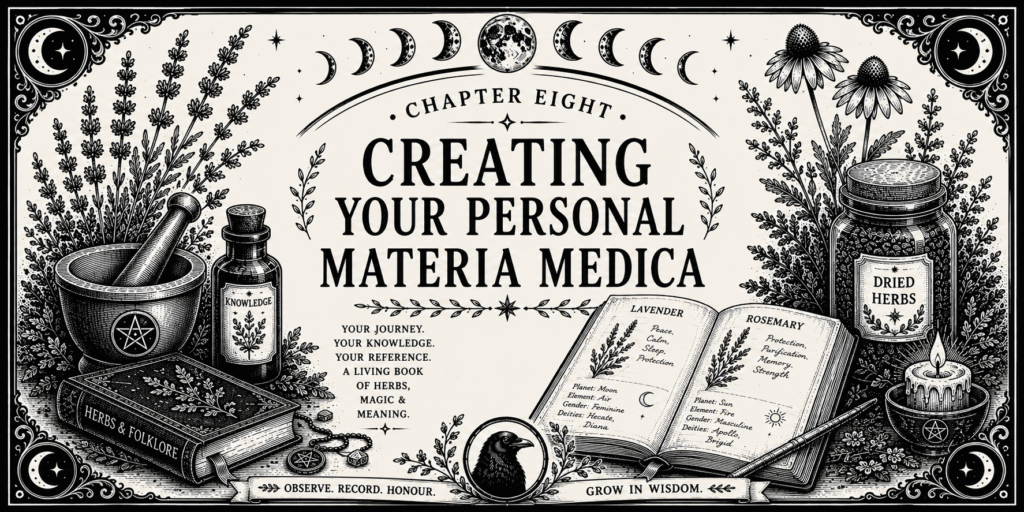

“A materia medica is not merely a collection of facts about plants. It is a record of what is known, what has been believed, what you have observed—and how carefully you have learned to tell the difference.”
Introduction
Over the previous seven chapters, you have explored herbs from several different directions.
You have learned to think about:
Plant identification and safety
Familiar magical herbs
Herbal correspondences
Infusions and teas
Infused oils, salves and balms
Incense and ritual herbs
Growing, harvesting and storing plants
Now it is time to bring all of that information together.
This final chapter is about creating your personal materia medica: a living reference work that grows alongside your herbal knowledge.
Historically, the term materia medica referred to collections of information about substances used medicinally, especially plants, minerals and animal products. Modern herbalists still use the term for systematic records describing individual herbs and their uses.
Within magical herbalism, your materia medica can become something broader.
It can record:
Botany
Growing information
Ecology
Safety
Traditional herbal use
Modern research
Folklore
Magical correspondences
Historical sources
Preparation methods
Personal observations
Recipes
Ritual experiences
Questions that remain unanswered
The important word here is personal.
Your materia medica should not simply become another copied correspondence book.
It should gradually reflect your own learning.
But personal does not mean uncritical.
A useful materia medica distinguishes clearly between:
botanical fact, documented historical use, modern evidence, folklore, modern magical correspondence and your own experience.
Those categories can sit beside one another.
They should not be quietly blended together until nobody can tell where a claim came from.
That distinction is what turns a collection of notes into a serious working reference.

What Is a Materia Medica?
For the purposes of this course:
A materia medica is an organised record of individual plants, documenting their identity, characteristics, uses, safety, history and your developing relationship with them.
It can be:
A handwritten book
A ring binder
A collection of index cards
A spreadsheet
A digital database
A Book of Shadows section
A combination of formats
There is no required aesthetic.
It does not need:
Beautiful handwriting
Antique paper
Wax seals
Botanical paintings
Perfect calligraphy
Those things can be enjoyable.
They are not what makes the information valuable.
Accuracy does.
Your Materia Medica Is Different From a Grimoire
The terms may overlap in modern practice, but it can be useful to distinguish them.
A materia medica records plants
Its focus is:
Identity
Safety
History
Preparations
Uses
Observation
A grimoire records magical practice
It might contain:
Spells
Rituals
Invocations
Correspondences
Divination
Spirit work
Magical theory
A Book of Shadows may contain both
Your personal system may combine everything in one volume.
That is completely acceptable.
The important issue is not what you call the book.
It is whether you can find and understand the information later.
Why Create Your Own?
You may wonder:
“Why not simply buy a good herbal encyclopaedia?”
You should use good reference books.
But creating your own record offers something different.
It forces you to:
Compare sources
Notice contradictions
Record botanical names
Think about safety
Identify where folklore came from
Observe living plants
Record actual preparation methods
Notice how your understanding changes
Writing something yourself requires greater engagement than highlighting somebody else’s page.
Your materia medica also becomes specific to:
Your local landscape
Your garden
The herbs you actually use
Your magical tradition
Your personal correspondences
Your climate
Your suppliers
Your experiences
Two responsible practitioners may therefore have quite different materia medicas.
A Living Document
Do not think of your materia medica as a book that must eventually be “finished.”
Plants are too complex for that.
Research changes.
Botanical names change.
Your own experience changes.
You discover new folklore.
A study is published.
You learn that an old correspondence came from a much later source than you assumed.
A plant you once understood primarily as a ritual ingredient becomes something you know intimately from growing it.
Leave space for revision.
A good materia medica contains phrases such as:
“Needs further research”
“Source uncertain”
“Earlier note corrected”
“Personal observation”
“Do not use internally”
“Conflicting evidence”
“Historical claim only”
These are signs of good scholarship.
Not failure.
The Most Important Rule: Label the Type of Information
Imagine you write:
Mugwort — dreams.
What does that actually mean?
Does it mean:
Mugwort has been used historically in dream-related folklore?
Modern witches associate it with dreaming?
Drinking it has been clinically demonstrated to create meaningful dreams?
You personally dreamed vividly after smelling it?
Someone on social media said it causes prophetic dreams?
Those are completely different statements.
Your materia medica should show which one you mean.
A simple system could use categories such as:
BOTANY
Scientifically established plant identity and morphology.
TRADITIONAL HERBAL USE
Documented historical or traditional applications.
MODERN EVIDENCE
Findings from contemporary scientific research.
FOLKLORE
Recorded folk beliefs and customs.
MAGICAL CORRESPONDENCE
Occult or witchcraft associations.
PERSONAL EXPERIENCE
Your observations and interpretation.
SAFETY
Known cautions, interactions and contraindications.
This one habit dramatically improves the quality of your herbal work.
Fact, Tradition and Experience
Throughout the course we have repeatedly separated these three things.
They deserve a permanent place in your materia medica.
Fact
Example:
Rosemary belongs to the mint family, Lamiaceae.
That can be checked botanically.
Tradition
Example:
Rosemary has been associated with remembrance in European funerary and commemorative customs.
This is a historical or folkloric statement.
Personal experience
Example:
Rosemary reminds me of my grandmother’s kitchen, so I use it in ancestral rituals.
This belongs to you.
All three can be valuable.
But your personal association should not be rewritten later as:
“Rosemary has always represented grandmothers.”
Nor should folklore become:
“Science proves rosemary summons ancestors.”
Good records preserve these distinctions.
Begin With Botanical Identity
Every plant entry should begin with identity.
At minimum, record:
Common name
Botanical name
Plant family
Part or parts used
You may also include:
Botanical synonyms
Local names
Historical names
Cultivar
Native range
Kew’s Plants of the World Online is particularly useful for checking accepted botanical names, synonyms, taxonomy and geographical distribution.
Botanical naming may seem less exciting than moon correspondences.
It is also what stops you confusing two different plants sharing the same common name.
Common Name
Record the name you actually use.
For example:
Common name: Lemon balm
Then add alternative names where useful.
Do not rely upon the common name alone.
Plants may have:
Multiple regional names
Old names
Trade names
Shared names
Botanical Name
Use the accepted scientific name.
For example:
Lemon balm — Melissa officinalis
Botanical names should ideally be italicised in formal writing.
The genus begins with a capital letter.
The species does not:
Melissa officinalis
not:
Melissa Officinalis
You do not need to become a professional taxonomist.
But learning this basic convention makes your notes much clearer.
Botanical Synonyms
Taxonomy changes.
A plant you know under one botanical name may appear under another name in an older book.
Record important synonyms where they help you connect sources.
For example:
Accepted name: ______
Older synonym: ______
This makes historical research much easier.
Kew’s databases are valuable here because they include accepted names and synonyms.
Plant Family
Record the botanical family.
For example:
Lamiaceae — mint family
Asteraceae — daisy family
Rosaceae — rose family
Family information can help you understand:
Botanical relationships
Plant structure
Identification
Possible allergy considerations
Shared characteristics
But do not assume that every member of a family has identical safety or uses.
A family is a relationship.
Not a recipe.
Plant Description
Describe the living plant.
Include:
Height
Growth habit
Stem
Leaves
Flowers
Fruit
Seeds
Root where relevant
Scent
Texture
Whenever possible, write part of this yourself after observing the plant.
For example:
“Leaves grow opposite one another. The edges are softly toothed. Crushing a leaf produces a bright lemon-like scent.”
Personal observation helps you learn identification much more effectively than copying a paragraph from a website.
Add Photographs or Drawings
Useful visual records include:
Whole plant
Leaf
Stem
Flower
Fruit or seed
Habitat
If drawing, you do not need artistic skill.
A practical sketch showing:
Leaf arrangement
Stem shape
Flower structure
can be extremely useful.
If adding photographs, label:
Date
Location
Growth stage
A photograph of the plant in January may look very different from the same species in June.
Pressed Plant Specimens
A pressed plant specimen can support study where:
Collection is legal
The plant is abundant
You have permission
It is not protected
Handling is safe
Never collect a protected or rare plant simply to fill a beautiful book.
You can instead use:
Photograph
Drawing
Fallen material
Purchased botanical specimen
Also remember that a dried pressed specimen should not later become an ingredient.
It is a study object.
Distribution and Habitat
Record where the plant naturally occurs and where it grows in your local environment.
Possible headings include:
Native range
Where is it indigenous?
Introduced range
Where has it become established elsewhere?
Habitat
Does it favour:
Woodland
Hedgerows
Dry grassland
Wet ground
Disturbed soil
Coast
Gardens
Local observations
Where have you seen it?
Do not confuse:
“I saw this growing beside a path”
with:
“This species always grows beside paths.”
Personal observations are valuable but limited.
Ecology
This section is often missing from magical herb books.
Include:
Pollinators
Birds or animals using the plant
Whether it is a host plant
Whether it spreads aggressively
Whether it is invasive locally
Its role in the habitat
This encourages you to see the plant as part of an ecosystem rather than an ingredient warehouse.
You may discover that the most meaningful magical correspondence develops from ecology.
A plant heavily visited by bees may acquire personal associations with:
Community
Cooperation
Industry
A plant reclaiming disturbed land may represent:
Resilience
Recovery
Persistence
Growing Information
If you cultivate the plant, record:
Seed or plant source
Sow date
Germination
Soil
Light
Water
Pot size
Hardiness
Flowering date
Harvest date
Winter behaviour
Pests
Disease
Propagation
Over several years, your personal records may become more useful than generic garden instructions because they describe how the plant behaves in your conditions.
Harvest Information
Record exactly what you harvested.
Include:
Plant part
Date
Growth stage
Weather
Time if relevant
Amount
Cultivated or wild
Site
Permission where relevant
Then record:
Fresh weight
Drying method
Drying duration
Final weight
Storage container
Batch code
This allows you to trace a jar back to its source.
Traditional Herbal Uses
This section requires careful language.
Instead of writing:
“Calendula heals everything.”
write:
“Calendula has a history of traditional topical use for…”
and record the source.
Traditional use can tell us:
How a culture used a plant
Which plant part was used
How it was prepared
What role it played
It does not automatically prove modern clinical effectiveness.
Traditional knowledge deserves respect without being exaggerated into scientific certainty.
Modern Evidence
You may wish to keep a short section on modern research.
This is where disciplined sourcing matters.
Ask:
Was the research in humans?
Animals?
Cells in a laboratory?
Was the herb itself studied or an isolated constituent?
What extract was used?
What dose?
How many participants?
Was there a control group?
Has the finding been replicated?
A laboratory experiment showing that a concentrated plant extract affects cells does not prove that drinking a household cup of tea will treat the same condition.
Likewise, a study of one standardised extract cannot automatically be applied to:
Dried herb
Tincture
Essential oil
Infused oil
Record the actual preparation studied.
Evidence Does Not Need to Be All-or-Nothing
Avoid two extremes:
“There is one study, therefore the herb definitely works.”
and:
“There is no large trial, therefore traditional knowledge is worthless.”
Instead use language such as:
Evidence is limited
Early research suggests
Clinical evidence is mixed
Traditional use is established, but modern evidence is insufficient
This preparation has not been studied directly
Accuracy often sounds less dramatic.
That is a strength.
Safety Section
Every materia medica entry should have a prominent safety section.
Do not leave safety buried at the bottom of the page.
Include headings such as:
Internal use
Is the plant normally used internally?
External use
Are there known irritation concerns?
Pregnancy and breastfeeding
Is safety established or uncertain?
Children
Is appropriate use established?
Medicines
Are interactions known?
Allergies
Does the plant family matter?
Liver or kidney concerns
Where relevant.
Duration
Is prolonged use inappropriate?
Essential oil
If one exists, what additional cautions apply?
Smoke
Is burning appropriate?
Pets
Are there relevant known concerns?
Herbal medicines can interact with conventional medicines, and NHS Specialist Pharmacy Service continues to recommend assessing interactions and patient-specific risks rather than assuming complementary products are harmless.
Pregnancy and Breastfeeding
Do not use a vague note such as:
“Probably safe.”
When reliable safety information is lacking, write:
Safety not established — seek appropriate professional advice.
Current NHS guidance emphasises that not all natural remedies are safe during pregnancy and advises discussing herbal remedies with a midwife, doctor or pharmacist.
Uncertainty should be recorded as uncertainty.
That is responsible practice.
Children
Do not simply convert an adult herbal dose by guessing.
Current NHS information cautions against herbal medicines for children because there may not be sufficient safety information.
Your entry might therefore say:
Children: Do not use medicinally without appropriately qualified guidance.
That is much more useful than leaving the category blank.
Medicine Interactions
When a potential interaction matters, record:
Which medicine or class
What interaction is reported
The source
Whether evidence is theoretical or documented
Date checked
Medicine information changes.
Include:
Last safety review: ______
That reminds you to recheck rather than treating the entry as permanent.
Adverse Reactions
If you personally react to an herb or product, record it.
Include:
Date
Plant/product
Preparation
Quantity
Route
Symptoms
Time before symptoms
Other ingredients
But do not use personal experience to diagnose yourself.
Suspected adverse reactions to herbal medicines can be reported through the UK’s MHRA Yellow Card system.
Toxicity
Be direct.
If a plant is dangerous, make that obvious.
You may use a clear symbol such as:
⚠ TOXIC — STUDY ONLY
or:
DO NOT INGEST
Do not bury toxicity beneath romantic folklore.
A poisonous plant can still have a fascinating entry containing:
Botany
History
Myth
Folklore
Art
Magical symbolism
without including experimental recipes.
Some herbal ingredients are legally banned or restricted in unlicensed medicines in the UK because of toxicity concerns, reinforcing why “traditional” and “safe” cannot be treated as synonyms.
Preparation Methods
Create a section showing which preparations are relevant.
For example:
Infusion
Is the plant commonly prepared this way?
Decoction
Which part?
Tincture
What type of preparation is traditionally documented?
Infused oil
Is the plant appropriate?
Balm or salve
For what non-medical purpose?
Incense
Is burning appropriate?
Culinary
How is it normally used?
Ritual-only
Is symbolic use safer than physical use?
You do not need to create every preparation for every herb.
Your materia medica should also tell you:
Do not make this preparation.
Record Exact Recipes Separately
A plant profile and a recipe are not the same thing.
Your plant page might say:
“Calendula flowers may be used in oil infusions.”
Your formulation section should contain the actual batch:
25 g dried plant
Specific carrier
Specific method
Dates
Batch code
Keeping those sections separate prevents general information from being mistaken for an exact formula.
Magical Correspondences
Now we come to the magical layer.
Possible headings include:
Protection
Love
Prosperity
Divination
Dream work
Ancestors
Cleansing
Courage
Luck
Healing symbolism
Boundaries
Creativity
But do not simply fill the page with every word you find online.
Ask:
Which correspondences appear repeatedly?
Where did they come from?
Are they historical?
Modern?
Personal?
What feature of the plant might explain them?
Your notes become far more useful when you record reasoning.
Element
If you use elemental correspondences, record:
Element: Fire
Then underneath:
Reason/source: Modern correspondence based upon warming aromatic character; other sources list Air.
Now future-you understands why the entry exists.
A single word without context becomes difficult to evaluate later.
Planet
Likewise:
Planet: Venus
Then record the source.
If another source gives Mercury, record the contradiction.
You do not need to erase one in order to preserve the other.
Write:
“Venus in Source A; Mercury in Source B. I currently use Venus for devotional work because…”
This is what a genuinely personal system looks like.
Deity Associations
Create separate categories.
For example:
Historically attested
Supported by historical evidence.
Later occult
Found in later magical literature.
Modern devotional
Used by contemporary practitioners.
Personal
Your own relationship.
Do not write:
“Sacred to Hecate since ancient times”
unless you have evidence supporting that specific plant association.
“Ancient” is not decorative language.
It is a historical claim.
Folklore
This may become one of the richest sections.
Record:
Folk names
Protective customs
Wedding traditions
Funeral customs
Seasonal beliefs
Household practices
Superstitions
Fairy lore
Witch lore
Weather lore
Regional sayings
Always note:
Country
Region
Historical period
Source
A Dorset folk belief and a Romanian folk belief should not quietly become one generic “European tradition.”
Place matters.
Folk Names
Old plant names can reveal how communities understood them.
Record the name and where you found it.
Do not assume every picturesque name is ancient.
Modern herbal websites sometimes invent or repeat names without sources.
Where the origin is uncertain, write:
Origin unverified.
That is infinitely better than accidentally teaching fiction as folklore.
Historical Sources
Record full enough information to find the source again.
Instead of:
“Found in an old herbal.”
write:
Culpeper, The English Physitian, 1652, entry for ______.
If using a modern edition, note that too.
For folklore:
Author
Book/article
Publication date
Page if available
Region discussed
Future research becomes far easier.
Sources Need Dates
Websites change.
Medical guidance changes.
Botanical taxonomy changes.
Include:
Accessed: August 2026
for important web material.
You may later discover that advice has been updated.
This is especially important for:
Medicines
Regulation
Protected species
Safety guidance
Use a Source Hierarchy
Not every source deserves equal weight.
A useful hierarchy might be:
For botanical identity
Prefer:
Kew
Botanical gardens
Floras
Taxonomic databases
University botany resources
Kew’s Plants of the World Online provides accepted plant names, synonyms and distribution information and is an excellent starting point.
For medical safety
Prefer:
NHS
MHRA
Specialist Pharmacy Service
Pharmacopoeias
Authoritative monographs
Peer-reviewed scientific literature
For history
Prefer:
Original historical texts
Museums
Archives
Academic historians
For folklore
Prefer:
Folklore collections
Local archives
Academic folklore research
Properly referenced ethnobotanical work
For magical practice
Use:
Historical occult texts
Clearly identified modern traditions
Reputable contemporary practitioners
Social media can give you ideas.
It should rarely be your final authority.
How to Record Source Quality
Create a simple code.
For example:
A — authoritative / primary
Botanical database, regulator, original historical text.
B — strong secondary source
Academic book or peer-reviewed paper.
C — established specialist reference
Professional herbal or folklore reference.
D — modern practitioner source
Useful for contemporary magical practice.
E — unverified
Blog, social-media graphic, unattributed correspondence chart.
This does not mean category D or E has no value.
It tells you what kind of claim it can reasonably support.
A TikTok video may tell you:
“Some modern witches use this plant for prosperity.”
It cannot establish:
“This plant was used for prosperity throughout ancient Europe.”
Avoid Citation Laundering
A claim can look well sourced because fifty websites repeat it.
But perhaps all fifty copied the same unsourced book.
Try to trace claims backwards.
Ask:
Where is the earliest source I can locate?
For example, if ten websites say:
“Victorians believed X.”
look for:
Victorian flora
Language-of-flowers books
Contemporary newspapers
Later historians citing original sources
Do not assume repetition proves antiquity.
Record Contradictions
Do not be frightened of disagreement.
A useful materia medica might say:
Element:
Fire — Sources A and B
Air — Source C
Personal use — Fire
or:
Traditional use: conflicting accounts.
Contradictions teach you something about how knowledge develops.
Erasing them creates false certainty.
Record What You Do Not Know
Create a box titled:
QUESTIONS
For example:
Where did the protection correspondence originate?
Is the deity association modern?
Is this plant safe around cats?
Does this old botanical name refer to the same species?
Was this use regional or widespread?
Questions turn your materia medica into a research project.
Without them, it easily becomes a scrapbook.
Personal Observations
This is where the book becomes uniquely yours.
Record experiences such as:
Scent
Growth
Seasonal changes
Texture
Flavour where appropriate
How a plant performs in your garden
Wildlife interactions
Ritual associations
Memories
Dreams
Emotional responses
But describe them carefully.
Instead of:
“Lavender definitely causes psychic dreams.”
write:
“On 14 August, I used lavender scent before meditation and later remembered a vivid dream. I found the association interesting but cannot establish that the lavender caused it.”
That entry remains useful.
And honest.
Observation Before Interpretation
Use two columns.
WHAT I OBSERVED
Three bees visited the lavender flowers during ten minutes.
MY INTERPRETATION
I personally associate lavender with community and gentle abundance.
This practice trains discernment.
It is useful far beyond herbalism.
Magical Results
If you use a plant in ritual, record:
Date
Intention
Herb
Form
Other ingredients
Ritual method
Practical action
Immediate experience
Outcome later
Do not record only apparent successes.
If nothing noticeable happened, write:
“No clear outcome observed.”
That matters.
Otherwise your magical journal becomes a catalogue of confirmation bias.
Do Not Rewrite the Prediction Afterwards
Suppose your spell was specifically intended to:
“Receive three new work enquiries this week.”
At the end of the week you received none but found £2 in a coat pocket.
Do not rewrite the record as:
“Prosperity spell worked!”
You may certainly note the £2 coincidence.
But record the original outcome honestly.
This makes your materia medica useful for genuine reflection rather than creating proof after the fact.
Personal Safety Notes
Your materia medica may include notes relevant only to you.
Examples:
“Do not use this carrier oil—I dislike the texture.”
“This tea causes me nausea.”
“The scent gives me a headache.”
“This herb performs badly in my shaded garden.”
These are valuable.
Label them:
Personal response — not universal.
Recipe Results
Suppose you create three calendula oil infusions.
Record them separately.
Batch 1
Olive oil.
Batch 2
Sunflower oil.
Batch 3
Different infusion duration.
Then compare:
Colour
Scent
Texture
Oxidation
Ease of use
Over time, your materia medica becomes a practical formulation record rather than a collection of copied recipes.
Commercial Information
If you make herbal products for a business, keep commercial documentation separate from personal magical notes.
Your professional records may need:
Formula
Supplier
Lot numbers
Safety documents
CPSR where appropriate
PIF information
Batch record
Product notification
Claims evidence
Labels
Do not rely on your Book of Shadows as the only compliance record.
The spiritual history of a plant and the regulatory documentation of a product serve different purposes.
THR Does Not Mean “Clinically Proven”
When researching commercially available herbal medicines, you may see the THR symbol.
Traditional Herbal Registration allows eligible products to be registered on the basis of longstanding traditional use alongside required quality and safety standards. The MHRA maintains a list of products granted a THR.
Do not write in your materia medica:
“THR proves the herb works.”
Instead note:
“Traditional-use registration exists for certain specific products/indications.”
The status applies to the registered product.
Not automatically to every homemade preparation containing that herb.
Herbal Products Can Cause Harm
Keep this principle visible throughout your book.
Herbal products may cause:
Adverse reactions
Interactions
Problems related to contamination or incorrect ingredients
The MHRA continues to operate pharmacovigilance for herbal medicines through the Yellow Card scheme, and UK safety guidance specifically recognises interaction risks between herbal and conventional medicines.
A materia medica that records only benefits and correspondences is incomplete.
Do Not Create Your Own Medical Prescribing Guide
Unless you have the appropriate clinical training, your materia medica should not become a personal diagnostic manual.
Avoid entries such as:
“For chest pain: take X.”
“For depression: use Y instead of medication.”
“For unexplained bleeding: drink Z.”
Instead record:
Traditional use: ______
Evidence: ______
Safety: ______
Professional assessment required for persistent or serious symptoms.
Your herbal study should increase respect for the limits of self-treatment.
Not reduce it.
Creating a Warning System
Colour coding can make safety information obvious.
For example:
Green
Ordinary culinary herb when used appropriately.
Amber
Additional cautions or interaction concerns.
Red
Potentially toxic / specialist guidance required.
Black
Study only / do not use.
This is only an organisational system.
It is not a scientific classification.
Explain your key clearly at the beginning of the book.
Add a “Method of Use” Matrix
For each plant, you could create:
| Method | Appropriate? | Notes |
|---|---|---|
| Food | ✓ / ? / ✗ | |
| Tea | ✓ / ? / ✗ | |
| Tincture | ✓ / ? / ✗ | |
| Topical oil | ✓ / ? / ✗ | |
| Balm | ✓ / ? / ✗ | |
| Incense | ✓ / ? / ✗ | |
| Ritual only | ✓ |
Use:
✓ = sufficiently researched and suitable in the intended context
? = requires further information
✗ = not appropriate
Do not assume a tick applies to everybody.
This is your research status.
Not universal permission.
Add a Confidence Rating
You may also rate how confident you are in a claim.
For example:
HIGH
Supported by multiple strong sources.
MODERATE
Supported but evidence or history is incomplete.
LOW
Frequently repeated but source unclear.
PERSONAL
Based upon your own observation.
UNVERIFIED
Needs investigation.
Imagine how useful this becomes when, three years later, you revisit a note claiming:
“Bay leaves under the pillow cause prophetic dreams.”
Instead of wondering whether you once researched it carefully, the page says:
Source confidence: Low — modern magical claim; historical origin not yet located.
That is excellent record keeping.
A Complete Materia Medica Template
Here is a structure you can use throughout the app.
1. PLANT IDENTITY
Common name:
Botanical name:
Plant family:
Synonyms:
Other names:
2. IDENTIFICATION
Growth habit:
Leaves:
Stem:
Flowers:
Fruit/seed:
Scent:
Similar species:
Dangerous lookalikes:
3. DISTRIBUTION & ECOLOGY
Native range:
Habitat:
Local status:
Wildlife value:
Conservation concerns:
4. CULTIVATION
Annual/biennial/perennial:
Light:
Soil:
Water:
Hardiness:
Propagation:
Flowering:
Harvest:
5. PARTS USED
Leaf:
Flower:
Root:
Seed:
Bark:
Other:
Mark clearly which are actually used.
6. TRADITIONAL HERBAL USE
Documented traditions only.
Include sources.
7. MODERN EVIDENCE
Summarise cautiously.
Record preparation studied.
8. SAFETY
Internal:
External:
Allergy:
Pregnancy/breastfeeding:
Children:
Medicine interactions:
Health-condition cautions:
Essential oil:
Smoke:
Pets:
Toxicity:
Safety information last checked: ______
9. PREPARATIONS
Infusion:
Decoction:
Tincture:
Oil:
Salve:
Food:
Incense:
Ritual:
10. FOLKLORE
Region:
Period:
Custom:
Source:
11. MAGICAL CORRESPONDENCES
Primary intentions:
Element:
Planet:
Season:
Direction:
Colours:
Deity associations:
For each, record the source or category.
12. PERSONAL CORRESPONDENCES
What does the plant mean to you?
13. GROWING NOTES
Your direct observations.
14. HARVEST RECORD
Where, when and how?
15. PREPARATION RECORD
What did you actually make?
16. RITUAL RECORD
What was the intention and outcome?
17. SOURCES
Full references.
18. QUESTIONS
What remains uncertain?
This creates an extremely strong plant profile.
Example Entry: Rosemary
Here is how a shortened entry might look.
Identity
Common name: Rosemary
Botanical name: Salvia rosmarinus
Family: Lamiaceae
Older botanical name: Rosmarinus officinalis
Observation
Evergreen aromatic shrub with narrow leaves. Strong scent released when leaves are touched.
Growing
Prefers good light and freely draining conditions.
Traditional and historical notes
European associations include remembrance and funerary custom.
Magical correspondences
Common modern associations:
Remembrance
Protection
Cleansing
Loyalty
Ancestors
Element
Conflicting modern sources: Fire/Air.
My system
Fire for active protection; Air when used in memory-focused work.
Safety
Assess method separately; essential oil should not be treated as equivalent to culinary herb.
Personal association
“Family kitchen, practical protection, remembrance.”
Questions
Trace earliest British funerary references.
Compare seventeenth-century planetary assignments.
Notice that the entry does not attempt to pretend every category has one final answer.
Example Entry: Mugwort
A mugwort page might immediately demonstrate why careful structure matters.
Identity
Common name: Mugwort
Botanical name: Artemisia vulgaris
Family: Asteraceae
Magical associations
Frequently linked in modern Western magical practice with:
Dreams
Divination
Lunar work
Thresholds
Folklore
Record regional customs separately rather than using one generic paragraph.
Safety
This section should be prominent before recipes are considered.
Potential allergy and pregnancy considerations require appropriate research.
Personal use
Perhaps:
“I prefer ritual sachet and incense-study applications rather than internal use.”
That is a perfectly valid conclusion.
A materia medica does not exist to convince you to consume every plant.
Example Entry: Belladonna
This is where the system becomes especially valuable.
Identity
Atropa belladonna
Status
⚠ HIGHLY TOXIC — STUDY ONLY
Historical interest
Poison history
Early modern associations
Folklore
Witchcraft imagery
Magical use
Symbolic study only.
Possible alternatives:
Illustration
Photograph
Written name
Historical research
Recipes
None.
This is excellent herbal practice.
Knowledge does not require experimentation.
Organising Alphabetically
The simplest system is:
A–Z by common name.
Advantages:
Easy to find
Familiar
Disadvantage:
Botanical relationships are less obvious.
Organising by Botanical Family
You might organise:
Lamiaceae
Lavender
Mint
Rosemary
Sage
Thyme
Asteraceae
Calendula
Chamomile
Mugwort
Yarrow
This helps botanical learning.
The disadvantage is that beginners may find it slower to locate a plant.
Organising by Magical Intention
You could organise sections such as:
Protection
Love
Divination
Prosperity
But plants fit multiple intentions.
This can lead to repeated entries.
A better solution is often:
Keep individual herb profiles alphabetically and create an intention index.
For example:
Protection
See:
Rosemary — p. 18
Nettle — p. 43
Hawthorn — p. 62
This keeps each plant’s complete information together.
Use an Index
Your future self will thank you.
Possible indexes include:
Plant index
Alphabetical.
Intention index
Love, protection, prosperity, etc.
Preparation index
Tea, oils, incense.
Safety index
Pregnancy cautions, toxic plants, allergens.
Seasonal index
Spring, summer, autumn, winter.
Planetary index
Sun, Moon, etc.
A digital materia medica can make this particularly easy through tags.
Paper Versus Digital
Both have advantages.
Paper
Advantages:
Tactile
Easy to sketch
Feels personal
No screen required
Disadvantages:
Harder to reorganise
Limited search
Corrections may become messy
Digital
Advantages:
Searchable
Easy to update
Can add photographs
Can duplicate templates
Can back up
Disadvantages:
Technology dependence
Less tactile
You may combine both.
For example:
Digital master reference + handwritten field journal.
That is an excellent system.
The Field Journal
A separate small notebook can travel with you.
Record:
Date
Place
Weather
Plant seen
Sketch
Photographs
Questions
Do not attempt to write complete herbal monographs while standing in a muddy field.
Observe first.
Research later.
Your Book Should Contain Corrections
Do not tear out every page when you learn something new.
Cross out the incorrect claim neatly and write:
CORRECTION — August 2026
Then explain the new information.
This creates a record of your learning.
It may be surprisingly valuable.
You will see how your practice became more careful over time.
Create a “Things I Used to Believe” Page
This can be fascinating.
For example:
I used to believe every magical correspondence was ancient.
I used to assume natural meant safe.
I used to think essential oils were simply stronger infused oils.
I used to believe one correspondence belonged universally to each herb.
I used to think the most ingredients created the strongest spell.
Then record what changed your understanding.
This encourages intellectual humility.
The Difference Between “Unknown” and “Mysterious”
This is particularly important in witchcraft.
When you cannot explain something, resist immediately writing:
“Magical.”
Sometimes the correct category is:
Unknown.
Unknown means:
More information is needed.
Several explanations remain possible.
You have not decided.
Mystery can be beautiful.
But uncertainty should not be used as proof of whichever explanation you prefer.
Your materia medica can hold uncertainty without resolving it prematurely.
Citation Practice
You do not need academic footnotes on every handwritten sentence.
But you should be able to locate important information again.
A simple system might be:
[K1] Kew Plants of the World Online
[N1] NHS herbal medicine guidance
[F3] Folk-Lore journal article
[C1] Culpeper edition
Then each entry can say:
Botanical name: [K1]
Historical use: [C1]
Pregnancy caution: [N1]
The reference section contains the full details.
This keeps pages readable.
Beware of AI-Generated Herbal Information
AI can be useful for:
Organising notes
Creating templates
Explaining terminology
Helping generate research questions
It should not be your sole authority for:
Plant identification
Toxicity
Drug interactions
Pregnancy safety
Clinical dosing
Legal compliance
Verify important claims with authoritative sources.
The same applies to:
Pinterest
TikTok
Instagram
Reddit
Blogs
Use them to discover questions.
Not to end the research.
Reviewing Your Materia Medica
Schedule periodic reviews.
Perhaps every six months.
Choose five entries.
Check:
Has the botanical name changed?
Are links still active?
Has safety guidance changed?
Did I ever locate the source of that folklore claim?
Have I gained new personal observations?
Do I still use the plant the same way?
Plant knowledge evolves.
Your reference should too.
Annual Safety Audit
Once each year, review your most frequently used herbs.
Especially those that are:
Consumed
Applied to skin
Used around children
Used around pets
Used by people taking medicines
Sold commercially
Check current authoritative guidance.
NHS Specialist Pharmacy Service maintains resources for checking complementary-product interactions, with information updated as evidence changes.
Do not assume a safety note copied five years ago remains the best available guidance.
A 12-Herb Beginner Materia Medica
Do not begin with 200 plants.
Choose perhaps twelve that you genuinely encounter.
For example:
Rosemary
Lavender
Peppermint
Lemon balm
Chamomile
Calendula
Rose
Nettle
Bay
Thyme
Yarrow
Mugwort
The exact list is yours.
You may choose plants that:
Grow locally
Are used regularly
Appear often in your practice
Interest you historically
Spend one month on each if you wish.
After one year, you could know twelve plants remarkably well.
That is far more valuable than possessing superficial correspondences for 300.
The One-Plant Month
A particularly useful learning exercise is dedicating one month to one herb.
During that month:
Week One — Botany
Learn:
Identity
Family
Growth
Habitat
Week Two — History
Research:
Traditional use
Folklore
Names
Historical sources
Week Three — Safety and preparation
Study:
Appropriate preparations
Cautions
Interactions
Storage
Week Four — Magical relationship
Explore:
Correspondences
Personal symbolism
Ritual use
Reflection
At the end of the month, write one-page summary:
“What I now understand about this plant.”
This prevents magical study from becoming a race.
Practical Exercise: Build Your First Full Entry
Choose one herb you already know reasonably well.
Do not choose something exotic.
Complete:
Identity
Botanical name and family.
Description
Write it in your own words.
Growing
How does it grow?
Ecology
What interacts with it?
History
Find at least one reliable historical source.
Traditional use
Describe without turning it into modern medical advice.
Modern evidence
Find an authoritative summary where relevant.
Safety
Check authoritative sources.
Folklore
Find a properly attributed belief.
Magical correspondence
Compare at least three magical sources.
Personal observation
Add your own experience.
Questions
List at least three things you still do not know.
This last section is compulsory.
Nobody truly finishes knowing a plant.
Practical Exercise: Source Audit
Choose one existing note from your Book of Shadows.
For example:
“Rosemary protects the home.”
Now ask:
Where did I first learn this?
Can I find the original source?
Is it folklore, modern witchcraft or personal belief?
Does the source specify a region?
Is there a practical historical reason for the association?
Have I accidentally described it as ancient?
Does it involve a safety claim?
Rewrite the entry accurately.
You may be surprised how much stronger it becomes.
Practical Exercise: Separate Five Claims
Take the plant lavender.
Write one statement under each category.
BOTANICAL
A factual statement about the plant.
HISTORICAL
Something documented historically.
SCIENTIFIC
A claim supported by appropriate modern evidence.
MAGICAL
A correspondence from a magical tradition.
PERSONAL
Something the plant means specifically to you.
This simple exercise teaches the structure of the entire chapter.
Practical Exercise: Create Your Safety Box
Design one standard box that appears on every plant page.
For example:
⚠ SAFETY CHECK
Correct species:
Part:
Internal use:
Topical use:
Pregnancy/breastfeeding:
Children:
Medicines:
Allergies:
Pets:
Smoke:
Last checked:
Then go back through your first twelve plants.
Complete every field.
When you do not know, write:
NOT YET VERIFIED
Never leave a blank that you may later mistake for “no risk.”
Practical Exercise: Build Your Correspondence Index
Create headings:
Ancestors
Cleansing
Courage
Creativity
Divination
Dreams
Friendship
Love
Prosperity
Protection
Release
Sleep
Wisdom
Under each, list only plants you have already researched.
Do not fill the index by searching “best herbs for protection.”
Build it from your completed profiles.
This means your magical index grows alongside actual plant knowledge.
Your Materia Medica and Intuition
Over time, you may discover that you begin reaching for herbs instinctively.
That is natural.
But because you have researched them properly, intuition rests upon a richer foundation.
Instead of:
“Something told me to use nettle.”
you may recognise that your mind already knows nettle through:
Its sting
Its growth
Its folklore
Its fibres
Its history
Your garden
Previous rituals
What feels spontaneous may contain layers of learned association.
That does not diminish intuition.
It makes it more interesting.
Your Materia Medica and Discernment
A good materia medica teaches you that:
“I experienced this”
is different from:
“This objectively happened.”
For example:
“I felt unusually calm while working with rose.”
is an observation.
“Rose emitted a calming spiritual frequency measured by my body.”
is an interpretation.
You may still believe the latter spiritually.
Record the difference.
Discernment is not disbelief.
It is accurate description.
The Ethics of Sharing Your Notes
If you later teach, blog or create an app from your research, remember:
Your readers may assume authority.
Therefore distinguish:
History
Folklore
Belief
Evidence
Safety
Personal practice
Do not quietly transform:
“In my own practice…”
into:
“Witches have always…”
And do not transform:
“Traditionally used…”
into:
“Scientifically proven…”
Your readers deserve to know which kind of statement they are reading.
The Ethics of Selling From Your Materia Medica
Suppose your personal notes say:
“Plantain — traditionally associated with skin soothing.”
That does not mean a homemade balm can legally be marketed as:
“Heals bites, eczema and wounds.”
Commercial formulation and claims create separate regulatory responsibilities.
Your materia medica is a learning tool.
It is not itself:
A CPSR
Product safety assessment
Medical licence
Food-business compliance document
Evidence that a claim is lawful
Keep those boundaries clear.
A Personal Disclaimer
At the beginning of your materia medica, write something like:
This book records botanical information, historical traditions, folklore, magical correspondences and personal observations. These categories are not interchangeable. Traditional use does not automatically establish modern medical effectiveness or safety. Health-related information is checked against reliable sources, but guidance may change and individual circumstances require appropriate professional advice.
This reminds you of the standard you want your work to meet.
Your Personal Materia Medica Code
Create your own principles.
For example:
I identify before I use.
I record the botanical name.
I distinguish folklore from evidence.
I never hide uncertainty.
I research safety separately from magical correspondence.
I record failed experiments as well as successful ones.
I do not invent ancient origins to make a practice sound important.
I respect living traditions.
I harvest only when lawful and appropriate.
I use fewer plants more thoughtfully.
I change my notes when better evidence appears.
I accept that “I don’t know” is sometimes the most accurate answer.
This becomes the ethical foundation of the book.
Common Materia Medica Mistakes
Copying without sourcing
You will eventually forget where the information came from.
Recording only common names
This creates identification problems.
Leaving out the plant part
Leaf and root may not be interchangeable.
Mixing medicine and magic
A healing correspondence does not establish clinical efficacy.
Calling everything “traditional”
Ask which tradition.
Calling everything “ancient”
Find the evidence first.
Ignoring contradictory sources
Record the disagreement.
Recording only positive outcomes
This creates confirmation bias.
Treating personal experience as universal
Label it clearly.
Writing exact doses without appropriate expertise
A study book should not become an unqualified prescribing manual.
Leaving out safety
A beautiful correspondence page without contraindications is incomplete.
Treating “no information found” as “safe”
It means unknown.
Never updating entries
Knowledge changes.
Making the book too beautiful to use
Your materia medica should tolerate:
Crossed-out notes
Mud
Tea stains
Corrections
Questions
It is a working tool.
Reflection Questions
What do I want my materia medica to become?
Will I use paper, digital format or both?
How will I organise the plants?
How will I record botanical synonyms?
Which sources will I use for taxonomy?
How will I separate fact, history, folklore and personal experience?
What will my safety warning system look like?
How will I indicate that information is unverified?
What does “traditional use” mean to me now?
How will I avoid presenting traditional use as proven medical effectiveness?
Which magical correspondence claims in my current notes have no source?
Which would I like to investigate first?
How will I record contradictory correspondences?
Do I want to use elemental and planetary systems?
How will I distinguish historical deity associations from modern ones?
What should always appear in a safety section?
How often will I review medicine-interaction information?
How will I record my own adverse reactions?
How will I document herbs that I grow?
What information will I record when harvesting?
How will I handle toxic plants?
How will I record a magical experiment honestly when nothing happens?
Which twelve plants would I most like to know deeply?
What source hierarchy will I use?
What will I do when two reputable sources disagree?
Which unanswered questions excite me most?
How will my materia medica remain useful rather than merely decorative?
What personal standards do I want every future entry to meet?
Finish with:
My materia medica does not need to contain every answer. Its value lies in showing clearly what I know, where that knowledge came from, what I have experienced and what I still have the humility to question.
Key Takeaways
A materia medica is an organised working reference about individual plants.
Your personal version can include botany, herbalism, history, folklore, magic and lived observation.
These categories should remain clearly distinguishable.
Botanical identity should come before correspondence.
Accepted names and synonyms can be checked using authoritative taxonomic resources such as Kew’s Plants of the World Online.
Every entry should record the plant part being discussed.
Traditional use is evidence of tradition, not automatic proof of clinical effectiveness.
Modern research should be interpreted according to the actual preparation, study type and evidence quality.
Safety deserves a prominent section on every plant page.
Herbal products can interact with conventional medicines, and interaction information should be reviewed from reliable, current sources.
Pregnancy, breastfeeding and childhood require particular caution rather than assumptions based upon the word “natural.”
Toxic plants can be studied without being used.
Magical correspondences should be sourced where possible.
Historical, modern and personal deity associations should not be presented as though they are identical.
Regional folklore should retain its geographical and historical context.
Personal experience is valuable when labelled as personal.
Contradictory information should be recorded rather than hidden.
“Unknown” is a legitimate category.
Recipe records should be separate from general plant information.
Commercial compliance documents are separate from a personal materia medica.
Entries should be reviewed and updated as knowledge changes.
Depth of knowledge about a small number of plants is more useful than superficial knowledge of hundreds.
A good materia medica becomes increasingly personal while remaining increasingly rigorous.
Closing Thoughts
When you began this Herbalism section, a herb may have looked like an ingredient.
A spoonful of dried leaves.
A flower in a jar.
A correspondence in a book.
Something for a tea.
Something for a spell.
Now you have the tools to see far more.
Behind one small sprig of rosemary you can recognise:
A botanical species
A member of a plant family
A living organism
A garden plant
A wildlife resource
A culinary ingredient
A historical remedy
A piece of folklore
A magical symbol
A possible safety consideration
A memory
A relationship
That complexity is why a materia medica can never truly be finished.
Each entry begins with a name.
Then another layer appears.
You grow the plant.
You discover an old custom.
A source contradicts something you believed.
You learn that a familiar correspondence is surprisingly modern.
You change your preparation.
You notice a bee visiting the flowers.
You discover a contraindication.
You remember a scent from childhood.
You conduct a ritual that changes how you understand the plant.
And the page grows.
Eventually, your materia medica stops looking like somebody else’s herbal encyclopaedia.
It begins looking like your path through the plant world.
But the strongest personal reference is not the one filled with the greatest number of confident statements.
It is the one you can trust.
The one where:
Facts have sources.
Traditions have contexts.
Folklore has locations.
Magical beliefs are named as beliefs.
Personal experiences remain personal.
Safety information is visible.
Uncertainty is not hidden.
Corrections are welcomed.
There is great power in knowing a plant.
There is greater wisdom in knowing how you know what you think you know about it.
So begin with one plant.
Write its correct name.
Look at it closely.
Find out where it grows.
Learn its history.
Check its safety.
Read the folklore.
Explore its magical symbolism.
Grow it if you can.
Record what happens.
Then turn the page.
Your materia medica will grow slowly.
That is exactly how it should grow.
Because just like the plants it records, genuine knowledge develops through:
attention, time, observation, patience and care.
Do not build a book of answers. Build a record of relationship, evidence, tradition and discovery.
Congratulations — Herbalism Complete 🌿
You have now completed the eight chapters of the Herbalism learning journey:
Herb Safety & Responsible Practice
Getting to Know Common Magical Herbs
Magical Herbal Correspondences
Making Herbal Infusions & Teas
Infused Oils, Salves & Balms
Incense, Smoke Blends & Ritual Herbs
Growing, Harvesting & Storing Herbs
Creating Your Personal Materia Medica
You now have something much more valuable than a collection of herbal recipes.
You have a framework for learning plants responsibly.